

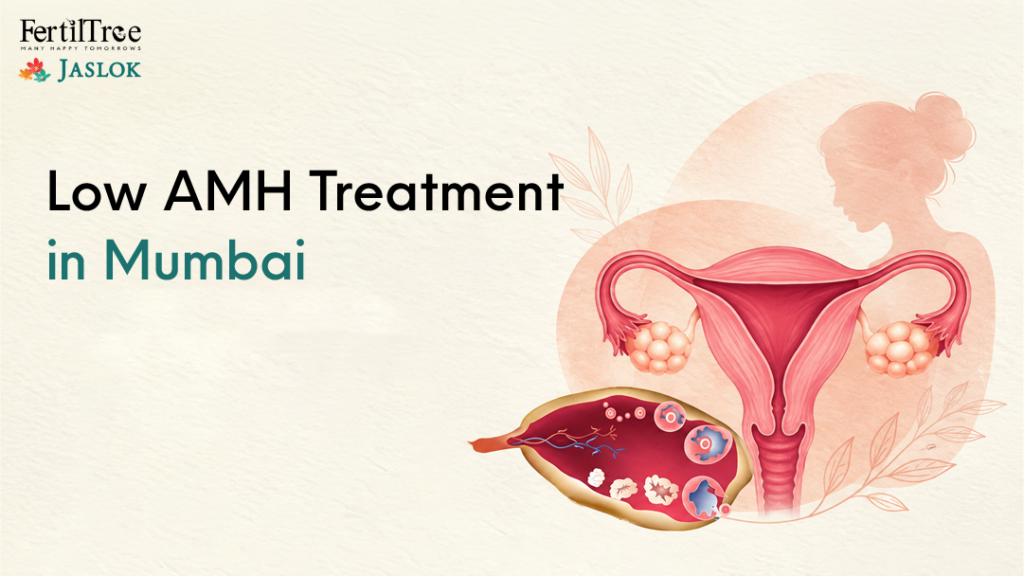
Low AMH Treatment in Mumbai
AMH <1.0 Defined as low | 1 in 10 Women under 40 | ≠ Infertile Pregnancy still possible | POSEIDON 2016 protocol guide | 50–60% Donor IVF success |
A low AMH result can feel like a door closing. It rarely is.
AMH — Anti-Müllerian Hormone — measures how many eggs your ovaries are likely to produce in response to stimulation. It does not measure whether those eggs can be fertilised, whether a pregnancy can implant, or whether you can conceive. That distinction is not semantics: women with AMH of 0.2 ng/mL have delivered healthy babies through protocol-adjusted IVF. Women with AMH of 0.8 ng/mL sometimes conceive without any treatment at all.
What low AMH does change is the treatment strategy. At Jaslok-FertilTree International Fertility Centre, Dr. G. Deshmukh Marg, Pedder Road, Mumbai — as part of a broader infertility treatment pathway — Dr. Firuza Parikh’s team classifies every low-AMH patient using the POSEIDON system, designs a protocol specific to that classification, and makes the embryo banking and donor egg conversations at the right clinical moment — not as a default first response.
What AMH Measures (and What It Doesn't)?
Anti-Müllerian Hormone is produced by granulosa cells surrounding small antral follicles in the ovaries. It is the most stable marker of ovarian reserve — measurable on any day of your cycle, unlike FSH and estradiol, which fluctuate significantly.
Here is the precise list of what AMH tells you and what it cannot:
AMH DOES tell you | AMH does NOT tell you |
Roughly how many antral follicles remain | Whether those eggs are chromosomally normal (age determines that) |
How your ovaries are likely to respond to stimulation drugs | Whether your fallopian tubes are patent |
Which IVF protocol is appropriate for you | Whether implantation will succeed |
Whether embryo banking across multiple cycles is advisable | Whether natural conception is impossible |
Source: NICE Guideline CG156. National Institute for Health and Care Excellence.
What Is a Normal AMH Level? Age-Specific Chart
AMH declines naturally with age. What matters is how your result compares to the expected range for your age group — not to a universal ‘normal’. A 42-year-old with AMH of 0.6 ng/mL is in a different clinical position than a 31-year-old with the same result.
CHART 1 — Median AMH Level by Age Group (ng/mL) — for reference only
Category | Visual | Value |
Under 28 | █████████████████░░░░░ | 3.5 |
28–32 | ██████████████░░░░░░░░ | 2.8 |
33–36 | ██████████░░░░░░░░░░░░ | 2.0 |
37–39 | ██████░░░░░░░░░░░░░░░░ | 1.2 |
40–42 | ███░░░░░░░░░░░░░░░░░░░ | 0.6 |
43–45 | █░░░░░░░░░░░░░░░░░░░░░ | 0.3 |
46+ | █░░░░░░░░░░░░░░░░░░░░░ | 0.1 |
Source: La Marca A et al. AMH as a predictive marker in ART. Hum Reprod Update.
AMH Level (ng/mL) | Category | Response to Stimulation | Clinical Next Step |
≥ 1.5 | Optimal | Good (8–15 eggs expected) | Standard protocol; proceed with IVF normally |
1.0 – 1.5 | Low-normal | Adequate (5–10 eggs) | Slightly higher starting dose; standard antagonist |
0.5 – 1.0 | Low | Reduced (3–6 eggs) | High-dose antagonist; banking discussed |
0.1 – 0.5 | Very low | Poor (1–3 eggs likely) | POSEIDON Group 3/4; embryo banking plan; Duostim option |
< 0.1 | Undetectable | Minimal or none | Natural cycle IVF or donor eggs; AFC review critical |
Always confirm AMH with a female fertility assessment that includes an antral follicle count (AFC) ultrasound. The AFC directly counts visible follicles and often gives a clearer picture than AMH alone — some women with low AMH show more follicles on scan than the blood test suggests.
POSEIDON Classification: The Modern Framework FertilTree Uses
The POSEIDON criteria (Patient-Oriented Strategies Encompassing IndividualizeD Oocyte Number), published by the ESHRE in 2016, classifies poor and suboptimal ovarian responders into four groups. This is the framework Dr. Parikh’s team uses to assign your IVF protocol — not a one-size-fits-all approach.
POSEIDON Group | Profile | AMH / AFC | Expected Response | FertilTree Protocol |
Group 1 | Under 35, unexpected poor response | AMH ≥ 1.2 / AFC ≥ 5 | Should respond well but didn’t | Protocol switch; higher dose; check technique and lab factors |
Group 2 | Over 35, unexpected poor response | AMH ≥ 1.2 / AFC ≥ 5 | Age affects quality more than quantity | Aggressive dose; PGT-A to select best embryo |
Group 3 | Under 35, expected poor response | AMH < 1.2 / AFC < 5 | Confirmed low reserve; young eggs | Banking strategy; DHEA/CoQ10 adjuncts; 2–3 cycles to accumulate |
Group 4 | Over 35, expected poor response | AMH < 1.2 / AFC < 5 | Low reserve + age-related quality concern | Dual trigger; banking; honest donor egg conversation at 2 failed cycles |
Source: Poseidon Group et al. A new poor ovarian response with POSEIDON criteria.
What Causes Low AMH?
AMH doesn’t drop randomly. These are the established contributors — some modifiable, most not:
Cause | How Common | Modifiable? | Notes |
Age-related decline | Most common | No — but timing matters | Natural; pace varies significantly between women |
Significant overlap | Partially | Endometriomas destroy follicular tissue; surgery compounds the loss | |
Prior ovarian surgery | Underrecognised | No (damage done) | Each cystectomy removes follicle-bearing cortex; minimise interventions |
Premature Ovarian Insufficiency | ~1% under 40 | Rarely | Autoimmune, genetic (Fragile X premutation, Turner syndrome), or idiopathic |
Chemotherapy / radiation | Dose-dependent | Preventable pre-treatment | Alkylating agents most damaging; fertility preservation before cancer Rx |
Smoking | Established accelerant | Yes — quitting helps | Smokers show accelerated AMH decline vs non-smokers; improvement after cessation |
Source: Ferraretti AP et al. ESHRE consensus on poor ovarian response.
Can You Get Pregnant With Low AMH? The Data Answers
Yes — and the evidence is clearer than most consultations make it sound. The critical distinction, embedded in NICE CG156, is that AMH predicts ovarian response to stimulation drugs. It does not predict live birth. A woman who produces three good-quality eggs from one IVF cycle has the same per-transfer odds as a woman who produced fifteen, as long as the embryos are comparable.
Live Birth Rate per Transfer by AMH Category at IVF (Protocol-Adjusted)
Category | Visual | Value |
AMH ≥1.5 ng/mL (optimal) | ████████████░░░░░░░░░░ | 38% |
AMH 1.0–1.5 ng/mL (low-normal) | ██████████░░░░░░░░░░░░ | 33% |
AMH 0.5–1.0 ng/mL (low) | ████████░░░░░░░░░░░░░░ | 26% |
AMH 0.1–0.5 ng/mL (very low) | ██████░░░░░░░░░░░░░░░░ | 18% |
AMH <0.1 (undetectable) — own eggs | ███░░░░░░░░░░░░░░░░░░░ | 10% |
AMH <0.1 — donor egg IVF at FertilTree | █████████████████░░░░░ | 55% |
Source: Broer SL et al. | SART Clinic Summary Report — donor egg 50–60% live birth per cycle.
The donor egg bar is deliberately shown here. When own-egg IVF has repeatedly failed, donor egg IVF bypasses the ovarian reserve problem entirely — using a pre-screened donor’s eggs and achieving the highest success rates of any fertility pathway for this diagnosis. See donor egg IVF cost in Mumbai for current pricing.
Low AMH Treatment Options at FertilTree: The Complete Picture
No drug or supplement reliably restores AMH to optimal levels. That is the honest clinical position. What exists are strategies to maximise outcomes within your current biology. Every option below has a specific POSEIDON group it works best for:
Treatment | How It Works | Best POSEIDON Group | Evidence | Cost Indicator |
DHEA + CoQ10 (adjunct supplementation) | DHEA provides androgen substrate for follicle growth; CoQ10 improves mitochondrial function in oocytes | Groups 3 & 4 (confirmed low AMH) 8–12 weeks before IVF | Moderate — Gleicher 2011; Bentov & Casper 2013; not guideline-standard | ₹1,500–₹3,000/month |
High-dose antagonist IVF (300–450 IU) | Higher starting gonadotropin dose maximises egg yield from limited follicle pool; antagonist prevents premature LH surge | All groups — primary IVF approach | Strong — ESHRE POSEIDON 2016; Pandian Cochrane 2010 | ₹1,00,000–₹1,60,000/cycle |
Embryo banking (accumulation IVF) | Multiple mild or standard cycles freeze all embryos; cumulative blastocysts transferred in a subsequent FET cycle | Groups 3 & 4 When <3 eggs per cycle expected | Moderate — increasing adoption; individualised decision | Same as IVF × number of banking cycles |
Duostim (dual stimulation) | Stimulates both follicular and luteal phase of one cycle — doubles retrieval opportunities per calendar month | Groups 3 & 4: To accelerate banking when time-critical | Emerging — Ubaldi FM et al. Fertil Steril 2016 | Add-on to IVF cost; discuss at consultation |
Natural cycle IVF | No stimulation — retrieves the one egg produced naturally; repeatable monthly | Group 4 (undetectable AMH, no response to drugs) | Moderate — specific scenarios only | ₹40,000–₹70,000/cycle |
Pre-screened donor eggs used — bypasses ovarian reserve entirely; highest success rate for low AMH | Group 4 after failed attempts; AMH <0.1 | Strong — 50–60% live birth per cycle |
Source: Gleicher N et al. Reprod Biomed Online | Pandian Z et al. Cochrane Database Syst Rev.
Embryo Banking Strategy: How Many Cycles Do You Need?
For POSEIDON Groups 3 and 4, the goal is to accumulate enough blastocysts to give one transfer a realistic chance. Here’s the approximate number of banking cycles typically needed based on expected egg yield per retrieval:
CHART 3 — Approximate Banking Cycles Needed to Reach 3 Blastocysts (Transfer Target)
Category | Visual | Value |
1–2 eggs per retrieval | ██████████████████░░░░ | 4 cycles |
3–4 eggs per retrieval | █████████░░░░░░░░░░░░░ | 2 cycles |
5–7 eggs per retrieval | ████░░░░░░░░░░░░░░░░░░ | 1 cycle |
8+ eggs per retrieval | ████░░░░░░░░░░░░░░░░░░ | 1 cycle (standard IVF) |
Source: Devesa M et al. | Reprod Biomed Online.
DHEA, CoQ10 and Vitamin D: What the Evidence Actually Shows?
These are the three most commonly recommended adjuncts for low AMH. Here’s an honest, source-by-source breakdown:
Supplement | Dose / Timing | Evidence For | Evidence Against / Caution | Verdict |
DHEA | 25–75mg/day × 8–12 weeks before IVF | Gleicher N et al. 2011 (improved response); Wiser A et al. 2010 (higher live births in randomised trial) | NICE/ASRM do not recommend routinely; DHEA is a hormone — can cause acne, hair loss, mood changes; not safe in PCOS (raises androgens) | Reasonable adjunct under specialist supervision for POSEIDON Groups 3 & 4; not self-prescribable |
CoQ10 | 200–600mg/day × 8–12 weeks before IVF | Bentov Y & Casper RF 2013 (improved oocyte mitochondrial function); Xu Y et al. 2018 (higher fertilisation rates in RCT) | No large randomised trial confirming live birth benefit specifically | Low-risk, reasonable to include; especially for women over 37 with low AMH |
Vitamin D | Supplement to 50+ nmol/L if deficient | Lerchbaum E 2012 (deficiency associated with lower AMH); Paffoni A et al. 2014 (higher clinical pregnancy with sufficient Vit D) | Effect is correction of deficiency, not supra-physiological dosing; test first | Test your 25-OH Vitamin D level; supplement if deficient — routine recommendation |
Folic acid / MTHFR | 400–800mcg/day (methylated form if MTHFR variant) | Standard preconception recommendation; MTHFR variants affect folate metabolism | No AMH-specific benefit; standard preconception care | Take regardless — neural tube protection and general preconception standard |
Source: Wiser A et al. Addition of dehydroepiandrosterone (DHEA) for poor-responder patients.
Lifestyle Changes That Genuinely Help
No lifestyle change will restore significantly lost ovarian reserve. But several factors have real peer-reviewed evidence for slowing decline and improving egg quality within your current reserve. The spermatogenesis equivalent here is the ovarian cycle — changes made today affect follicle health over the next 3 months.
Factor | Specific Impact | Evidence Level | Timeline |
Quit smoking | Slows follicular depletion; reduces DNA damage in oocytes | Strong — Waylen AL et al. Hum Reprod Update 2009 | AMH improvement begins within 3 months of cessation |
Achieve BMI 18.5–24.9 | Higher BMI associated with lower AMH; ovarian function improves with normalisation | Moderate — Moran LJ et al. 2011 | Gradual; 3–6 months for meaningful change |
Reduce alcohol (<4 units/week) | Excessive alcohol accelerates oxidative stress in follicles | Moderate — Rossi BV et al. 2011 | Reduction shows benefit within one ovarian cycle (3 months) |
Limit endocrine disruptors (BPA, phthalates) | Plasticisers associated with accelerated follicular loss | Emerging — Machtinger R et al. 2018 | Replace plastic food storage; filter drinking water |
Stress reduction (validated mind-body) | High cortisol may suppress ovarian function indirectly | Weak but plausible — Palomba S et al. 2018 | Yoga, mindfulness, or counselling concurrent with treatment |
Low AMH and Egg Freezing: Should You Act Now?
If you’ve received a low AMH result but aren’t ready to have a baby yet — this section is specifically for you. The question isn’t whether to freeze. It’s whether freezing now, while your AMH is at current levels, is better than waiting. For most women with AMH below 1.0 and under 38, the answer is yes.
Egg freezing in Mumbai preserves the eggs available now — at their current quality — before the reserve declines further. For women with POSEIDON Group 3 profiles (confirmed low reserve but under 35), egg freezing is often the most time-efficient decision possible. See the egg freezing cost page for Mumbai pricing.
Your Specialist: Dr. Firuza Parikh
Dr. Firuza Parikh M.D., D.G.O., D.F.P., F.C.P.S., Dip.N.B.E., Ph.D. Yale University School of Medicine (IVF & Reprod. Endocrinology) 38 yrs reproductive medicine | 41 yrs obs & gynae 20,000+ babies | 60+ countries | Founded India’s 1st private IVF centre 1989 Ph.D. research: chromosomal aneuploidy in embryos — directly relevant to poor responder IVF Awards: ET Healthcare ICON in IVF 2019 & 2022 | 40+ honours | FertilTree Low AMH Protocol — 5 Differences: ✔ POSEIDON group assigned at consultation (not Bologna — newer standard) ✔ AFC + AMH reviewed together — number alone never decides your plan ✔ Embryo banking plan set out if expected yield < 3 eggs/cycle ✔ DHEA/CoQ10 discussed with evidence level stated honestly ✔ Donor egg conversation at appropriate clinical moment — not as default |
5 Questions to Ask Your Specialist at the First Appointment
- ‘Which POSEIDON group am I in — and how does that change my protocol?’ A specialist using POSEIDON is working from the current 2016 classification, not the older 2011 Bologna criteria.
- ‘What did my AFC show — and does it match my AMH?’ If AFC and AMH diverge, AFC often tells the more useful story.
- ‘At my AMH level, how many eggs can we realistically expect per cycle?’ The number directly shapes whether banking is worth planning.
- ‘When would you recommend moving to donor eggs — and what would that look like?’ Understanding the threshold in advance removes emotional shock if it’s reached.
- ‘Should I start DHEA or CoQ10 now — and for how long before my cycle starts?’ The answer tells you whether the team has considered adjuncts and has a protocol for them.
Your Next Step at FertilTree Mumbai
The first appointment maps your full picture. Not just the AMH number — the AFC, your history, the protocol recommendation, and a written plan including costs before anything starts.
Before You Come
At the Appointment
What You Leave With
Collect your most recent AMH result (any lab is fine)
AFC ultrasound if Day 2-5 of cycle — done at FertilTree
POSEIDON group assigned; protocol recommendation in writing
Note any prior IVF cycles and egg counts retrieved
DHEA/CoQ10 candidacy assessed; blood panel ordered if not done
Banking plan if applicable; blastocyst target number stated
Write your key question: own eggs vs donor, time pressure, cost ceiling
Honest probability discussion — own-egg vs donor, by your specific numbers
Itemised cost breakdown before any financial commitment
Frequently Asked Questions
Can I get pregnant with low AMH naturally?
Yes — particularly if AMH is in the 0.5–1.0 ng/mL range and you’re under 37. Low AMH reflects reduced reserve, not zero eggs. Ovulation still occurs. Time is the key variable: if natural conception doesn’t happen within 6 months of trying (3 months over 35), a fertility assessment is advisable before reserve declines further.
What AMH level is needed for IVF?
There is no minimum AMH required for IVF. NICE guideline CG156 explicitly states AMH cannot be used to exclude patients. Even with undetectable AMH, natural cycle IVF or Duostim can retrieve eggs. The AMH level determines which protocol to use and whether embryo banking is advisable — not whether you can attempt treatment.
What is the cost of AMH test and low AMH treatment in Mumbai?
AMH blood test: ₹1,200–₹2,500. Complete fertility test panel (AMH + AFC + Day 2 bloods + thyroid + prolactin): ₹5,000–₹10,000. IVF per cycle: ₹1,00,000–₹1,60,000 (excluding medication). FertilTree provides an itemised breakdown after the first consultation before any commitment.
Does endometriosis cause low AMH?
Yes — particularly if you’ve had ovarian endometriomas or surgery to remove them. Endometriotic cysts and the surgery itself both destroy follicle-bearing ovarian cortex. If you have both endometriosis and a low AMH result, the treatment plan needs to address both simultaneously — surgical and fertility management often need to be co-ordinated carefully.
How many banking cycles do I need?
It depends on how many eggs your ovaries produce per retrieval. If you typically yield 1–3 eggs per cycle, the team plans 3–4 banking cycles to accumulate 3–5 blastocysts before transfer. If PGT-A testing is added, more embryos are needed since testing selects only chromosomally normal ones. This is mapped out in writing at the first appointment.
Is donor egg IVF the only option for undetectable AMH?
Not necessarily. Some women with AMH <0.1 still respond to Duostim or natural cycle IVF and go on to have pregnancies with their own eggs. The donor egg discussion becomes appropriate when 2+ own-egg cycles have retrieved no eggs, or when PGT-A shows all retrieved embryos are abnormal. At FertilTree, donor egg IVF achieves 50–60% live birth rates per cycle — significantly higher than own-egg IVF for very low AMH — but it is a recommendation, not a mandate.
Should I freeze my eggs if my AMH is low?
If you’re under 38 and not yet trying to conceive, the answer is almost always yes — freeze now, while your eggs are at their current quality and quantity. Every month without action when AMH is already declining is a month’s worth of reserve lost. Book a consultation that includes an AFC assessment alongside AMH.
What is POSEIDON classification and why does it matter?
POSEIDON is the 2016 ESHRE system for classifying poor ovarian responders into four groups based on age, AMH, AFC, and stimulation history. It matters because Group 1 (young, unexpected poor response) and Group 4 (older, expected poor response) need completely different protocols — the same high-dose approach applied to both would be inappropriate. Asking your clinic ‘which POSEIDON group am I in?’ is a quick way to assess how individualised your protocol really is.