

Egg Freezing in Mumbai
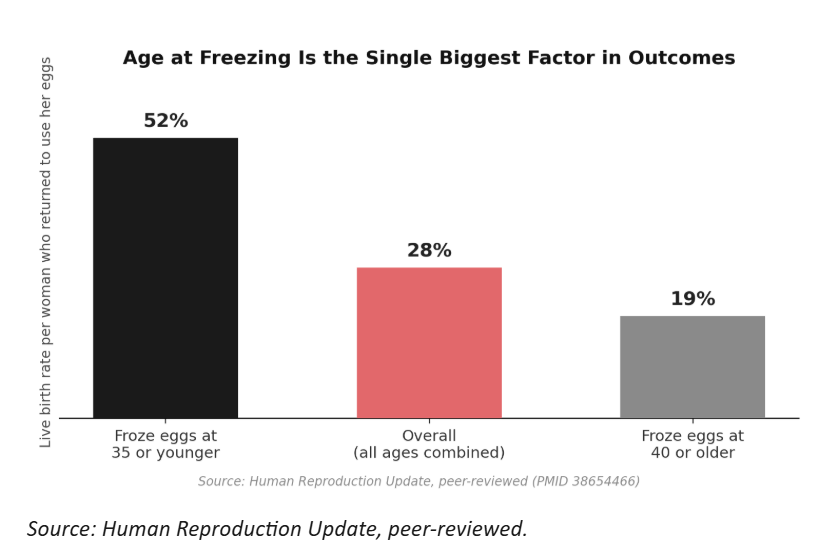
52% of women who freeze eggs before 35 go on to have a live birth.
By age 40, that number is 19%.
Those aren’t estimates — they come from a peer-reviewed study of nearly 1,500 women who actually returned to use their frozen eggs, published in Human Reproduction Update.
That gap is the single most important fact about egg freezing — and it is precisely why timing matters more than almost any other variable in this decision.
At Jaslok-FertilTree International Fertility Centre on Dr. G. Deshmukh Marg, Pedder Road, Mumbai, egg and embryo freezing has been a core clinical specialty for over three decades — led by Dr. Firuza Parikh, India’s most decorated IVF specialist, with 38 years of experience and more than 20,000 babies delivered for families across 60+ countries.
This page gives you the real age-stratified success data, an honest cost breakdown for Mumbai, and a clear explanation of every step in the process — so you can make this decision with evidence instead of marketing language.
Meet Your Specialist: Dr. Firuza Parikh
Dr. Firuza Parikh is Director of the Jaslok-FertilTree International Fertility Centre, 8th Floor, Jaslok Hospital, Dr. G. Deshmukh Marg, Pedder Road, Mumbai 400026. She trained at KEM Hospital, Seth G.S. Medical College, and Nowrosjee Wadia Maternity Hospital, then completed specialist IVF training at Yale University School of Medicine under Dr. Alan DeCherney, later serving as Visiting Professor of Obstetrics and Gynaecology at Yale (1992–2005).
Qualifications: M.D., D.G.O., D.F.P., F.C.P.S., Dip.N.B.E., Ph.D. | 38 years in reproductive medicine | 20,000+ babies delivered from over 60 countries | Founded India’s first hospital-based IVF centre at Jaslok Hospital (1989). Egg and embryo freezing are explicitly listed among her core clinical specialties.
Credential / Achievement | Detail |
Training | Yale School of Medicine (IVF & Reproductive Endocrinology) |
Founded | India’s 1st hospital-based IVF centre — Jaslok Hospital, 1989 |
Experience | 38 yrs reproductive medicine | 41 yrs obs & gynae |
Outcomes | 20,000+ babies | 60+ countries |
Awards | ET Healthcare ICON in IVF — 2019 & 2022 | 40+ honours |
Core Specialty | Egg & embryo freezing | IVF | ICSI | PGT |
Understanding the Egg Freezing Process: What to Expect at Every Step
Step 1: Initial Consultation and Assessments
Your specialist evaluates ovarian reserve through two key tests: an AMH (Anti-Müllerian Hormone) blood test — a marker of how many eggs your ovaries currently hold — and an antral follicle count (AFC) — an ultrasound that directly counts the small resting follicles visible in both ovaries. Together with a full medical history, these give you a realistic starting picture before any decisions are made. A female fertility test visit at FertilTree covers both.
Step 2: Ovarian Stimulation
Hormone injections over roughly 10–14 days encourage the ovaries to mature multiple eggs at once, with regular blood tests and ultrasounds tracking the response. Most women under 38 will have around 7–14 eggs collected in a single cycle, though this varies with ovarian reserve. Women over 38 may need two cycles to reach a target egg count for a strong chance at a live birth.
Step 3: Egg Retrieval
A minor procedure under sedation, typically 20–30 minutes, retrieves the mature eggs directly from the ovaries using a fine needle guided by ultrasound. Most patients return home the same day and resume normal activities within 1–2 days.
Step 4: Cryopreservation (Vitrification)
Eggs are flash-frozen using vitrification — a rapid-cooling technique (cooling at rates exceeding 20,000°C per minute) that prevents ice crystal formation inside the cell, which was the main cause of damage in older slow-freeze methods. Vitrification is now the international clinical standard. Large recent cohort studies presented at ASRM report thaw survival rates in the 88–91% range with modern vitrification, once eggs are eventually thawed for use.
What the Data Actually Says About Egg Freezing Success
A large peer-reviewed analysis in Human Reproduction Update followed nearly 1,500 women who returned to actually use their frozen eggs — not just froze and never came back — and tracked live birth outcomes by age at freezing:
Age at Freezing | Live Birth Rate (per patient who returned to use eggs) |
≤ 35 | ~52% |
36–37 | ~38% |
38–39 | ~28% |
≥ 40 | ~19% |
Age at freezing also determines how many eggs you actually need. ASRM-derived estimates for a roughly 70% chance of at least one live birth:
Age at Freezing | Approx. Mature Eggs Needed for ~70% Chance of 1 Live Birth |
30–34 | ~14 mature eggs |
35–37 | ~15 mature eggs |
38–40 | ~26 mature eggs |
Source: ASRM Practice Committee guidance, as summarized in current fertility-outcomes literature.
What Happens to Your Eggs, Step by Step?
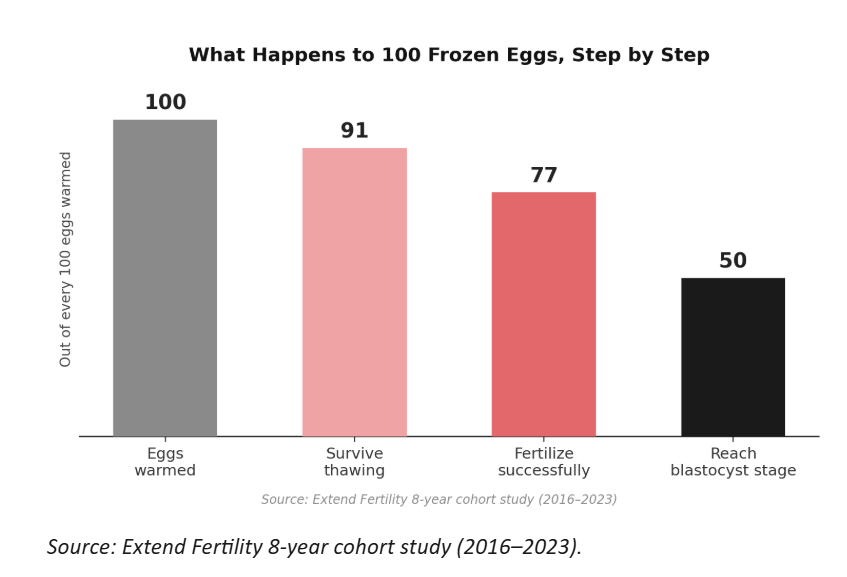
Freezing the eggs is only the first hurdle. An 8-year cohort study by Extend Fertility (2016–2023) tracked what actually happens from warming through to a viable embryo. Here is the realistic funnel, starting from 100 eggs warmed:
Stage | Approximate Outcome | Notes |
Eggs warmed | 100 eggs | Starting point |
Survived warming | ~89 eggs (89%) | Modern vitrification survival; 88–91% range across cohorts |
Successfully fertilized | ~67 eggs (75% of survived) | Standard ICSI fertilization rate |
Developed to blastocyst | ~34 embryos (51% of fertilized) | Day 5/6 blastocyst development rate |
Transferred blastocysts → live birth | ~40–50% per transfer (age-dependent) | Live birth rate per embryo transfer; higher for eggs frozen before 35 |
Is Egg Freezing Right for You? A Quick Checklist
None of these confirm you should freeze your eggs on their own — they are reasons to book a consultation and see your own numbers at FertilTree’s Pedder Road, Mumbai clinic. They are not a diagnosis:
- You’re in your late 20s to late 30s and not planning pregnancy in the next 1–2 years
- You don’t currently have a partner, or aren’t ready to use donor sperm
- You have a family history of early menopause or premature ovarian insufficiency
- You’ve been diagnosed with a condition that affects ovarian reserve over time, such as PCOS or endometriosis
- You’re about to start chemotherapy, radiation, or another treatment that could affect fertility
- You want the option preserved while you focus on career, education, or other priorities
Egg Freezing vs. Other Ways to Preserve Fertility
Option | What’s Frozen | Needs Partner/Donor Sperm Now? | Best For |
Egg freezing | Unfertilized eggs (oocytes) | No | Preserving options before you’ve decided on a partner |
Embryo freezing | Fertilized eggs (embryos) | Yes | Couples ready to commit to a partner/donor now |
Waiting, no preservation | Nothing | N/A | Only advisable if age or health is not expected to be a factor |
The Benefits of Egg Freezing for Women in Mumbai
Delaying Parenthood on Your Own Timeline
For women in Mumbai’s career-driven neighbourhoods — from Bandra to BKC, Worli to Andheri — freezing eggs at a younger age decouples the biological clock from career, education, or relationship timing. The eggs themselves don’t age further once vitrified, even though you do. You’re not postponing a decision; you’re preserving the quality of the decision you’ll eventually make.
Medical Reasons to Freeze
Egg freezing is also a standard option before treatment for conditions that affect ovarian reserve over time, including PCOS and endometriosis, as well as before chemotherapy for cancer patients — where fertility preservation can mean the difference between having biological children after recovery or not.
Better Odds With IVF Later
Because the success rate chart shows outcomes drop significantly with age at freezing, eggs frozen in your early 30s and later thawed for a frozen embryo transfer carry meaningfully better odds than eggs retrieved fresh at an older age. The biology you preserve today is the biology that does the work later.
Top Considerations Before Freezing Your Eggs
Age Matters More Than Almost Anything Else
ASRM guidance generally recommends freezing before 35, and notes diminishing returns freezing past 38 — not because the procedure stops working, but because you need far more eggs per attempt at a live birth, as the success rate table above shows. The egg count required jumps from ~14 mature eggs at age 30–34 to ~26 at age 38–40 for the same 70% chance at a live birth.
Cost of Egg Freezing in Mumbai
Costs vary by clinic and what’s bundled into the quote. Medication, retrieval, and annual storage are often priced separately. Current market estimates for Mumbai clinics generally fall in the ₹1,50,000–₹2,80,000 range per cycle — but this does not include medication (which varies by protocol) or annual storage. FertilTree’s egg freezing cost breakdown page gives you the clinic’s current itemized pricing rather than a market estimate.
Emotional and Physical Preparation
Hormone injections and a minor surgical procedure are physically manageable for most women but not trivial. Daily self-administered injections for 10–14 days, plus clinic visits every 2–3 days for monitoring, require planning around your work schedule. FertilTree’s team includes counseling support for patients who want help managing the emotional dimension — which is common and valid, particularly for those freezing for medical reasons.
Why Choose FertilTree for Egg Freezing in Mumbai?
Led by Dr. Firuza Parikh — Egg Freezing Is Her Core Specialty
Egg and embryo freezing is listed among Dr. Firuza Parikh’s specific areas of clinical expertise, alongside IVF, ICSI, and preimplantation genetic testing — not a service added on top of an unrelated specialty. She has practiced at Jaslok Hospital, Pedder Road, Mumbai since founding India’s first hospital-based IVF centre there in 1989.
Modern Vitrification Technology
FertilTree uses current-generation vitrification with thaw survival rates in the 88–91% range reported in peer-reviewed literature — consistent with what leading international programs achieve. The clinic also works alongside its genetics and PGT programme for couples who want preimplantation genetic testing built into their future IVF cycle.
Transparent, Itemized Care
From initial consultation through long-term storage, FertilTree provides an itemized cost breakdown before you commit to anything. You can also visit for the clinic’s current pricing structure. Contact the team at +91-22-66573175 or visit the 8th Floor, Jaslok Hospital, Dr. G. Deshmukh Marg, Mumbai 400026.
About Dr. Firuza Parikh
Dr. Firuza Parikh is the Director of the Jaslok-FertilTree International Fertility Centre in the Department of Assisted Reproduction and Genetics at Jaslok Hospital, Dr. G. Deshmukh Marg, Pedder Road, Mumbai 400026. She completed her undergraduate and postgraduate medical training at KEM Hospital, Seth G.S. Medical College, and Nowrosjee Wadia Maternity Hospital in Mumbai, then trained further in IVF and reproductive endocrinology at Yale University School of Medicine under Dr. Alan DeCherney, later serving as Visiting Professor of Obstetrics and Gynaecology at Yale (1992–2005).
She holds an M.D., D.G.O., D.F.P., F.C.P.S., Dip.N.B.E., and a Ph.D., with 38 years of experience in reproductive medicine and IVF specifically — 41 years in obstetrics and gynaecology overall. In 1989, she established the first IVF centre within a private hospital in India at Jaslok Hospital. Her listed areas of clinical expertise explicitly include egg and embryo freezing, alongside IVF, ICSI, donor eggs, and preimplantation genetic testing.
Her team has delivered more than 20,000 babies for couples from over 60 countries, and she has received over 40 professional honours, including the Economic Times Healthcare ‘ICON in IVF’ award in both 2019 and 2022.
F.A.Q.
What is the success rate of egg freezing?
It depends heavily on age at freezing. Peer-reviewed data, (Human Reproduction Update) shows a live birth rate of ~52% for women who froze at 35 or younger, versus ~19% for those who froze at 40 or older — not the flat 30–50% figure often cited without age context.
How long can frozen eggs be stored?
Frozen eggs can be safely stored for many years — often a decade or more — with no significant loss in quality once vitrified. Current evidence shows no decline in clinical outcomes from prolonged cryostorage.
What is the cost of egg freezing in Mumbai?
It varies by clinic and what’s included. Market estimates for Mumbai generally run ₹1,50,000–₹2,80,000 per cycle; FertilTree provides an itemized quote after consultation. Note that medication costs are usually additional and vary by ovarian response.
Who is a good candidate for egg freezing?
ASRM guidance generally favors freezing before 35, with diminishing returns — and significantly more eggs needed per attempt — past 38. Women up to 40 can still benefit, but the numbers change substantially. An AMH test and antral follicle count at FertilTree will give you your personal picture.
Is egg freezing painful?
Ovarian stimulation involves daily hormone injections for 10–14 days, which most women tolerate well. Egg retrieval is done under sedation, so you shouldn’t feel the procedure itself, though mild cramping afterward is common. Most patients return to normal activity within a day or two.
Do I need a partner to freeze my eggs?
No — unlike embryo freezing, egg freezing doesn’t require sperm at the time of freezing, since the eggs are stored unfertilized. You can make decisions about fertilization when and if you choose to use them.


