
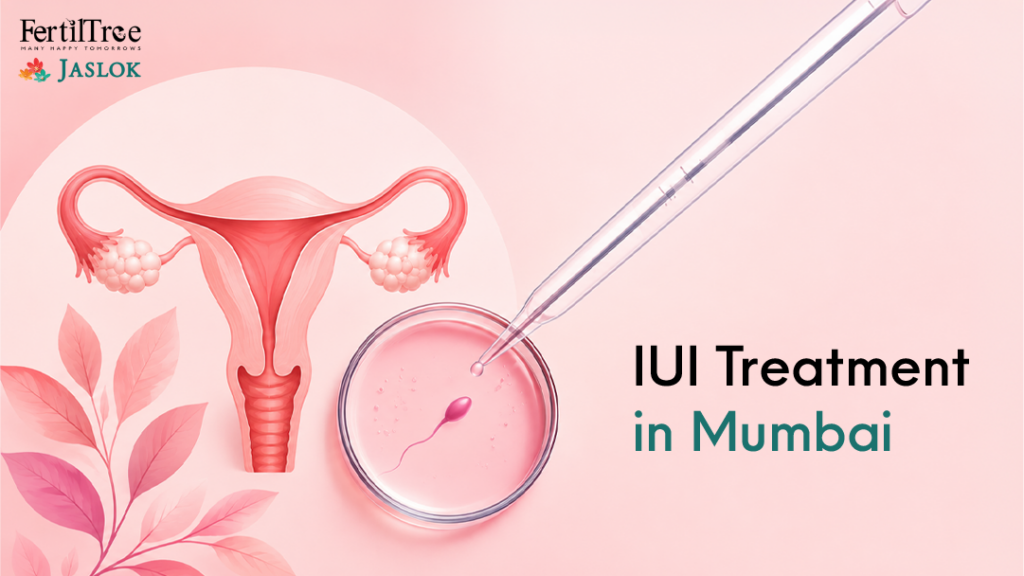
IUI Treatment in Mumbai
15–25% Success per cycle | < 10 min Procedure time | ₹10K–25K Cost per cycle | No Surgery No anaesthesia |
Most couples researching IUI ask the same two questions: does it actually work, and is it the right starting point for my situation? The honest answer to both depends entirely on your diagnosis — which is exactly why this page leads with data, not reassurance.
IUI — Intrauterine Insemination — is the least invasive assisted reproductive technology available. It is 4–8x cheaper than IVF, requires no surgery, and for the right candidates, achieves clinical pregnancy rates that make it a genuinely worthwhile first step. At Jaslok-FertilTree, part of Mumbai’s leading fertility programme, IUI success rates run 15–25% per cycle — and cumulative success over 3 cycles climbs to 40–55%.
What Is IUI? (And How It Differs From IVF)
Intrauterine Insemination places washed, concentrated sperm directly inside the uterus at the time of ovulation. The procedure bypasses the cervix, cuts the distance sperm needs to travel, and dramatically increases the number of motile sperm reaching the fallopian tubes. Fertilisation still happens naturally, inside the body — unlike IVF where fertilisation occurs in a laboratory.
That distinction matters practically: IUI works with your biology. IVF steps around it. IUI is appropriate when the core reproductive machinery is functional but needs a targeted assist. When the biology itself is the problem — blocked tubes, zero sperm, severe endometriosis — IVF or ICSI is the right tool, not IUI.
The IUI Process: Step by Step
Step | When | What Happens | What to Expect |
1 | Day 2–3 | Baseline ultrasound + blood tests (FSH, LH, AMH, Estradiol). Both partners assessed. | Two appointments; results same day at FertilTree |
2 | Day 3–12 | Ovarian stimulation — oral Letrozole or Clomiphene, or low-dose injections. Follicles monitored every 2–3 days. | 2–3 monitoring scans; mild bloating possible |
3 | Day 12–14 | hCG trigger injection when follicle reaches 18–20mm. Confirms exact ovulation timing. | Single injection; insemination 36 hrs later |
4 | Day 14–15 | Semen preparation in lab (takes ~90 mins). IUI procedure — catheter placed, sperm deposited. Under 10 minutes. | Mild cramping; resume normal activity same day |
5 | Day 14–28 | Progesterone luteal support. Two-week wait. | No heavy lifting; blood test confirms pregnancy at Day 28 |
Source: ASRM Practice Committee. Optimizing natural fertility.
Who Should (and Shouldn't) Choose IUI?
IUI isn’t the answer for every couple. Here’s the clinical decision framework:
Diagnosis | IUI Appropriate? | Reason |
Unexplained infertility | ✅ Yes | First-line recommendation — NICE CG156 supports 6 cycles for couples with normal anatomy and sperm |
PCOS / ovulation disorders | ✅ Yes |
|
Mild male factor (TMC >5M) | ✅ Yes | Post-wash TMC >10M gives best IUI outcomes; 5–10M is borderline (ASRM 2021) |
Cervical factor | ✅ Yes | IUI bypasses the cervix entirely — directly addresses the problem |
Single women / donor sperm | ✅ Yes | Pre-screened donor sperm gives IUI success rates comparable to natural conception |
Blocked fallopian tubes | ❌ No | IUI requires at least one patent tube — blocked tubes make fertilisation impossible via IUI |
Severe male factor (TMC <5M) | ❌ No | Below 5M TMC, ICSI is significantly more effective — see our male infertility page |
Severe endometriosis (Stage 3–4) | ❌ No | Anatomical distortion typically means IVF is needed |
3+ failed IUI cycles | ⚠️ Escalate | ASRM recommends considering IVF after 3–4 unsuccessful IUI cycles |
Source: Intrauterine insemination: a committee opinion. Fertil Steril 2023.
If PCOS is your primary diagnosis, read our dedicated PCOS treatment in Mumbai page for the complete picture, including ovulation induction protocols. For ovulation disorders beyond PCOS — including hypothalamic dysfunction and hyperprolactinaemia — the same IUI pathway typically applies once ovulation is successfully triggered.
IUI Success Rates by Age and Diagnosis
This is the section most patients want first, and most clinics obscure. Here’s what peer-reviewed and national authority data actually shows — with FertilTree’s own reported outcomes included.
CHART 1 — IUI Live Birth Rate by Age at Treatment (HFEA 2022 Data)
Category | Success Rate | % |
Under 35 | ██████████████░░░░░░ | 18% |
35–37 | ███████████░░░░░░░░░ | 14% |
38–39 | █████████░░░░░░░░░░░ | 11% |
40–42 | ██████░░░░░░░░░░░░░░ | 7% |
43+ | ███░░░░░░░░░░░░░░░░░ | 4% |
Source: HFEA (Human Fertilisation and Embryology Authority).
CHART 2 — IUI Success Rate by Indication at FertilTree, Mumbai
Category | Success Rate | % |
PCOS / ovulation disorder | ██████████████████░░ | 22% |
Donor sperm (single/same-sex) | ████████████████░░░░ | 20% |
Unexplained infertility | █████████████░░░░░░░ | 16% |
Cervical factor | ████████████░░░░░░░░ | 15% |
Mild male factor (TMC 5–10M) | █████████░░░░░░░░░░░ | 11% |
Source: Jaslok-FertilTree International Fertility Centre.
Cumulative IUI Success: Why Multiple Cycles Change the Maths?
Per-cycle success rates understate IUI’s real value. Here’s the cumulative picture — this is the data that should drive your decision about how many cycles to try:
Cycle Number | Per-Cycle Rate | Cumulative Success | Clinical Guidance |
Cycle 1 | 15–20% | 15–20% | First attempt — full diagnostic value regardless of outcome |
Cycle 2 | 13–18% | 28–38% | Most clinics review cycle data and adjust protocol here |
Cycle 3 | 12–16% | 40–54% | ASRM: clinical decision point — discuss IVF if no pregnancy |
Cycle 4 | 10–14% | 50–62% | Diminishing returns begin; IVF offers better per-cycle odds |
Source: Veltman-Verhulst SM et al. Intra-uterine insemination for unexplained subfertility.
IUI vs IVF: The Decision Framework
The right choice depends on your specific diagnosis, age, and how many cycles you can realistically attempt. Our detailed IUI vs IVF comparison guide covers this in depth. The summary version:
Factor | IUI | IVF/ICSI |
Fallopian tubes required | At least 1 open and functional | Not needed — lab fertilisation |
Sperm quality threshold | Post-wash TMC ≥5M | Single viable sperm (ICSI) |
Fertilisation | Inside the body (natural) | In the laboratory (controlled) |
Invasiveness | No surgery, no anaesthesia | Egg retrieval under sedation |
Cost per cycle (Mumbai) | ₹10,000 – ₹25,000 | ₹1,00,000 – ₹1,80,000+ |
Success per cycle | 15–25% (FertilTree) | 38–42% (FertilTree) |
Time per cycle | 3–4 weeks | 4–6 weeks |
Typical cycles before review | 3–4 | 1–2 |
Bottom line: Start with IUI if your tubes are open, sperm count is adequate, and the cause is mild or unexplained. Move to IVF if those conditions aren’t met, or if three IUI cycles have not resulted in pregnancy.
Sperm Count Requirements for IUI: The Numbers That Matter
Your male partner’s semen analysis result determines whether IUI is viable. The key metric is post-wash Total Motile Count (TMC) — not the raw ejaculate count:
Post-Wash TMC | IUI Recommendation | Reasoning |
>10 million | ✅ Strong IUI candidate | Best IUI outcomes; ASRM upper-tier threshold |
5–10 million | ⚠️ IUI possible, discuss with specialist | Borderline; success rates lower; consider protocol optimisation |
1–5 million | ⚠️ IUI unlikely to succeed | IVF/ICSI discussion warranted; some centres still try |
<1 million | ❌ ICSI recommended | IUI is not appropriate; see male infertility evaluation |
Source: ASRM Practice Committee. Intrauterine insemination.
If the semen analysis is showing borderline results, our male infertility specialist team evaluates the full picture — including DNA fragmentation and hormonal panel — before making a recommendation. Getting a proper sperm analysis done before starting IUI is non-negotiable.
IUI Treatment Cost in Mumbai: Complete Breakdown
One of IUI’s strongest advantages is cost. Here’s what to budget for a complete cycle in Mumbai:
Component | Mumbai Range | FertilTree Notes |
Initial consultation (Dr. Firuza Parikh) | ₹3,000 | Covers history, both-partner assessment, treatment plan |
Female fertility tests (AMH, FSH, Estradiol, AFC) | ₹2,000 – ₹5,000 | Day 2-3 bloods + ultrasound |
Semen analysis /sperm-analysis-test-cost-mumbai/ | ₹800 – ₹2,000 | Done simultaneously; post-wash TMC determines IUI viability |
Ovulation induction medication | ₹1,500 – ₹8,000 | Oral agents lower; gonadotropin injectables higher |
Monitoring scans (2–3 per cycle) | ₹1,500 – ₹4,500 | Follicle tracking; hCG trigger |
IUI procedure + sperm preparation | ₹4,000 – ₹10,000 | Includes lab processing and insemination |
Progesterone luteal support | ₹500 – ₹1,500 | 14-day post-procedure |
TOTAL per cycle (all-in estimate) | ₹13,300 – ₹34,000 | Substantially below IVF at ₹1,00,000+ |
Your IUI Specialist: Dr. Firuza Parikh
Dr. Firuza Parikh M.D., D.G.O., D.F.P., F.C.P.S., Dip.N.B.E., Ph.D. Director, Jaslok-FertilTree International Fertility Centre Experience: 38 yrs reproductive medicine | 41 yrs obs & gynae Training: Yale University School of Medicine, USA Outcomes: 20,000+ babies | 60+ countries Awards: ET Healthcare ICON in IVF 2019 & 2022 | 40+ honours | IUI at FertilTree — What Sets It Apart: ✔ Both partners evaluated before Cycle 1 ✔ Letrozole or gonadotropin protocols based on your AFC ✔ Semen analysis on Day 1 — not after IUI fails ✔ Post-cycle review and written plan before leaving ✔ Transparent escalation framework: 3 cycles → IVF discussion |
In 1989, Dr. Parikh founded India’s first IVF centre in a private hospital at Jaslok Hospital, Mumbai. The centre has since performed over 1,500 Preimplantation Genetic Testing procedures and delivered babies for couples from 60+ countries.
What You Can Do to Improve IUI Success Rates?
| Factor | Male Impact | Female Impact | Evidence |
| Quit smoking | Sperm DNA damage ↓ | Egg quality ↑ | Strong — Kovac et al., Fertil Steril 2015 |
| Reduce alcohol (<4 units/week) | Testosterone & morphology ↑ | Hormone balance ↑ | Moderate — Muthusami & Chinnaswamy, 2005 |
| BMI 18.5–24.9 | Testosterone ↑ | Implantation rate ↑ | Strong — Sermondade et al., 2012 |
| Avoid scrotal heat (laptops, hot baths) | Motility ↑ | N/A | Moderate — Hjollund et al., 2000 |
| Folic acid (woman, 400mcg/day) | N/A | Neural tube protection ↑ | Strong — NICE CG156 |
| Vitamin D (if deficient) | Motility ↑ | Ovarian reserve markers ↑ | Moderate — Lerchbaum & Obermayer-Pietsch, 2012 |
Next Steps: Starting IUI at FertilTree Mumbai
The first appointment covers everything. Both partners are assessed, tests are ordered, and you leave with a written treatment plan and cost breakdown — not a generic brochure and a follow-up date.
Before You Come In | At the First Appointment | After the Consultation |
Note cycle day count (Day 1 = first day of period) | Physical exam + history for both partners | You receive a written treatment plan |
Bring any previous semen analysis or fertility tests | Day 2-3 blood tests + ultrasound if cycle timing aligns | Itemised cost breakdown before any commitment |
Write down questions — especially about your specific diagnosis | Referral for HSG (tube patency test) if not done | IUI Cycle 1 typically starts within the same cycle |
Frequently Asked Questions
What sperm count do I need for IUI?
Post-wash Total Motile Count (TMC) ≥5 million is the ASRM minimum for IUI. Above 10 million gives the best results. Below 5 million, the team typically recommends upgrading to ICSI.
Can I do IUI with PCOS?
Yes — PCOS is one of the most responsive diagnoses for IUI. PCOS treatment at FertilTree uses Letrozole-based induction, which the NEJM study (Legro 2014) showed achieves higher live birth rates than Clomiphene in PCOS patients.
How many IUI cycles before IVF?
3–4 cycles is the ASRM-recommended threshold. After that, cumulative IUI success plateaus while IVF’s per-cycle rate (38–42% at FertilTree) becomes significantly more efficient per time and money spent.
Is IUI covered under insurance in India?
Partial coverage is possible when IUI is prescribed for a diagnosed medical condition. Purely elective fertility treatment coverage varies by policy. See our page on health insurance and fertility treatment in India for a full breakdown.
What is the difference between IUI and IVF?
IUI places sperm inside the uterus — fertilisation happens naturally in the body. IVF retrieves eggs surgically, fertilises them in a laboratory, and transfers embryos back. IUI is cheaper and less invasive but has lower per-cycle success rates.
Do I need to rest after IUI?
No strict bed rest is needed. Most women resume normal activities the same day. Strenuous exercise and sexual intercourse are typically avoided for 48 hours. Moderate activity and a normal diet are fine.


