

Male Infertility Specialist in Mumbai
If you and your partner have been trying to conceive without success, it’s easy to assume the difficulty lies with the woman. That assumption is wrong more often than most people expect: peer-reviewed clinical literature places male factors as a contributor in roughly half of all infertility cases — either alone or alongside a female-side cause. A male infertility specialist in Mumbai can pinpoint exactly what’s happening and build a treatment plan around it, instead of treating male fertility as an afterthought to a broader IVF workup.
At Jaslok-FertilTree International Fertility Centre, Dr. G. Deshmukh Marg, Pedder Road, Mumbai — led by Dr. Firuza Parikh, India’s most decorated IVF specialist with 38 years of experience and over 20,000 babies delivered — a semen analysis is part of the first-appointment workup for every couple, not an afterthought.
This page covers how male infertility is diagnosed at every stage, which causes are correctable and which require ART to work around, what the treatment success data actually says, and realistic cost ranges for each pathway — so you can make informed decisions from day one.
If you are experiencing fertility issues, you may need the expertise of a male infertility specialist in Mumbai. Recent 2025 data reveal India faces a significant infertility crisis, with approximately 27.5 million affected individuals, where male factors contribute to 50% of cases—a trend driven by lifestyle, pollution, and hormonal issues.
Fertiltree, one of the leading fertility clinics in Mumbai, offers comprehensive care and advanced treatment options for men facing infertility challenges. We understand that this can be an emotional and stressful journey, which is why our experienced specialists are here to support you through every step of the process.
Meet the Specialist: Dr. Firuza Parikh
Dr. Firuza Parikh is Director of the Jaslok-FertilTree International Fertility Centre, 8th Floor, Jaslok Hospital, Dr. G. Deshmukh Marg, Pedder Road, Mumbai 400026. She completed specialist IVF and reproductive endocrinology training at Yale University School of Medicine under Dr. Alan DeCherney, later serving as Visiting Professor of Obstetrics and Gynaecology at Yale (1992–2005).
Male-factor infertility is explicitly among her core clinical specialties, alongside ICSI, IMSI, and preimplantation genetic testing. Her team has delivered over 20,000 babies for couples from 60+ countries, including a large volume of cases where male-factor causes were the primary or contributing diagnosis.
Credential / Achievement | Detail |
Training | Yale School of Medicine — IVF & Reproductive Endocrinology |
Founded | India’s 1st hospital-based IVF centre — Jaslok Hospital, 1989 |
Experience | 38 yrs reproductive medicine | 41 yrs obs & gynae |
Outcomes | 20,000+ babies | 60+ countries |
Awards | ET Healthcare ICON in IVF — 2019 & 2022 | 40+ honours |
Core specialties | Male-factor infertility | ICSI | IMSI | Egg & embryo freezing | PGT |
Where Male Factor Actually Fits Into Couple Infertility?
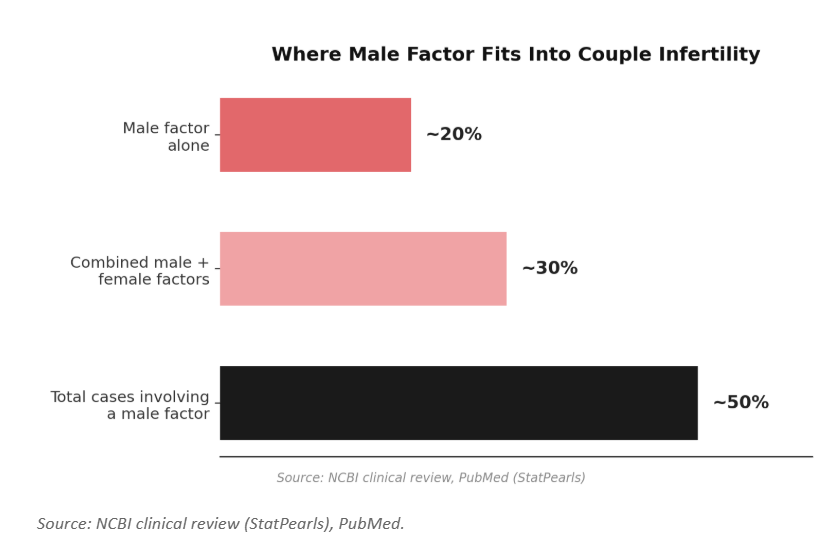
According to StatPearls — one of the most widely cited clinical references in reproductive medicine — male-factor infertility breaks down as follows across couples presenting to fertility specialists:
Category | Proportion of Infertility Cases | Clinical Implication |
Male factor only | ~20% of all couples | Semen analysis sufficient as first test; no female workup needed before addressing male cause |
Male + female factor combined | ~30% of all couples | Both partners need simultaneous workup; treating only one side is likely insufficient |
Female factor only | ~40% of all couples | Male factor has been ruled out |
Unexplained | ~10% of all couples | All standard tests normal; advanced testing or empirical ART may be indicated |
Signs That Point to a Male-Factor Evaluation
None of the following confirms infertility on its own — they are reasons to get evaluated, not a diagnosis. A semen analysis is the only way to know:
- No pregnancy after 12 months of regular, unprotected intercourse (6 months if the female partner is over 35)
- Pain, swelling, or a lump in or around the testicles — possibly indicating varicocele or infection
- Reduced sexual desire, or difficulty with erection or ejaculation
- Testicles that are noticeably smaller or firmer than usual
- History of mumps after puberty, undescended testicles, groin surgery, or significant genital trauma
- Signs of a hormonal imbalance — reduced facial or body hair, or breast tissue changes (gynaecomastia)
- Prior chemotherapy or radiation treatment, which can damage sperm production
Common Causes — and How Often Each One Shows Up?
A proper diagnosis replaces guesswork with data. Here’s what the evidence says about how often each cause is actually behind male infertility:
Cause | How Common? | Correctable? |
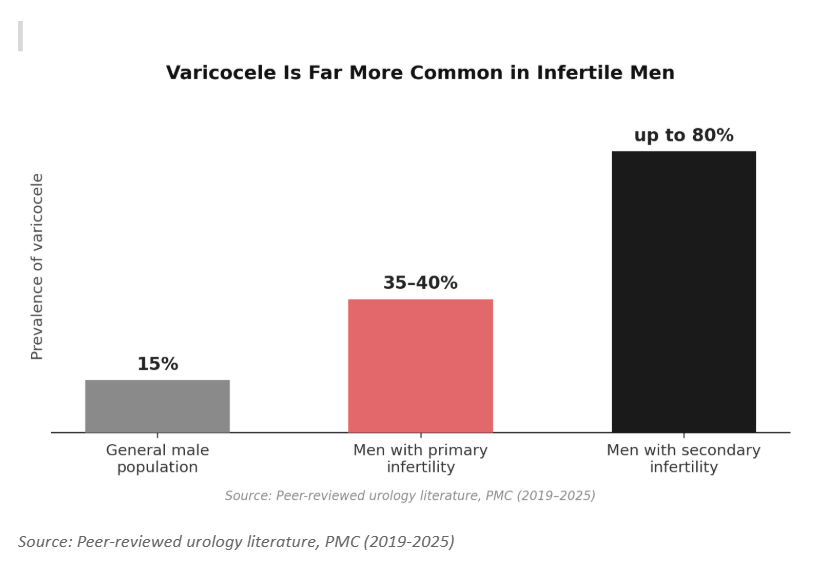
Varicocele (dilated testicular veins) | ~15% all men; ~35–40% with primary infertility | Yes — microsurgical varicocelectomy; outpatient |
Idiopathic (no identifiable cause) | ~30% of male infertility cases | Managed empirically via ART/ICSI |
Genetic (Y-chromosome microdeletion / Klinefelter) | ~10–15% of cases | Not reversible — ICSI/TESA can retrieve sperm |
Hormonal imbalance (↓ testosterone, ↑ FSH/LH) | Meaningful contributor in oligospermia | Often yes — targeted hormone therapy |
Obstructive azoospermia (blocked ducts) | ~40% of azoospermia cases | Often surgically correctable — or PESA/TESA |
Non-obstructive azoospermia | ~60% of azoospermia cases | Sperm retrieval (TESA) possible in ~50% |
Sperm DNA fragmentation | 20–40% of infertile men have high DFI | Lifestyle change + ICSI/IMSI; antioxidants |
Sources: peer-reviewed urology literature (PMC, 2019–2025).
What the Terminology on Your Semen Report Means?
When your semen analysis report comes back, it uses clinical terms that are rarely explained to patients. Here is what each one means:
Term | Definition | Clinical Significance |
Oligospermia | Sperm concentration below 16 million/mL (WHO 2021 threshold) | Reduces fertilisation probability; severity matters — mild vs severe oligospermia have very different treatment paths |
Azoospermia | Zero sperm in the ejaculate — either no production (non-obstructive) or a blockage (obstructive) | Does not mean infertility is untreatable — TESA or PESA can retrieve sperm for ICSI in many cases |
Asthenospermia | Total motility below 42%, or progressive motility below 30% (WHO 2021 thresholds) | Motility matters as much as count — sperm that cannot swim effectively cannot reach or penetrate an egg |
Teratospermia | Fewer than 4% of sperm with normal morphology (Kruger strict criteria, WHO 2021) | High rates of abnormally shaped sperm; IMSI selects the best-shaped sperm at 6000x magnification before injection |
Oligoasthenoteratospermia (OAT) | Combined deficiency in count, motility AND morphology | Most common pattern in male-factor infertility; typically managed with ICSI |
DNA Fragmentation Index (DFI) | Percentage of sperm with damaged or fragmented DNA strands | High DFI (>25–30%) associated with implantation failure and miscarriage even when count/motility appear normal |
Diagnosis: What to Expect at FertilTree?
Step 1: Initial Consultation
Your specialist reviews medical history, lifestyle factors, prior surgeries, medications, and how long you have been trying to conceive. Family history matters — some genetic causes (Klinefelter syndrome, Y-chromosome microdeletions) run in families or connect to other conditions. History of undescended testicles, mumps orchitis, vasectomy, or groin surgery also changes the diagnostic pathway immediately.
Step 2: Semen Analysis
A semen analysis is usually the first concrete test — and the one most often ordered too late. It measures sperm count (concentration), motility (how sperm move), and morphology (sperm shape) against WHO 2021 reference values. Knowing which parameter is abnormal — or which combination — changes the entire treatment approach. The WHO table below shows the current thresholds. See also sperm analysis test cost in Mumbai for FertilTree’s current pricing.
Step 3: Hormonal and Genetic Testing
If semen parameters are abnormal, hormone tests check testosterone, FSH (follicle-stimulating hormone — reflects how hard the pituitary is working to stimulate sperm production), and LH. Elevated FSH with low sperm count often signals testicular failure rather than a blockage — a critical distinction that changes treatment options entirely. Genetic testing (karyotype and Y-chromosome microdeletion panel) is added for men with severe oligospermia or azoospermia.
Step 4: Treatment Plan
Lifestyle change, medication, surgery, or ART — the plan depends entirely on what the first three steps found. Most men land somewhere in the middle of that range, and the majority of causes have a viable treatment pathway. The plan is set out in writing after the investigation, with costs broken down before anything is started.
What a Semen Analysis Report Actually Means
Lab reports are measured against the WHO Laboratory Manual for the Examination and Processing of Human Semen, 6th Edition (2021) — the current global reference standard:
Parameter | WHO 2021 Lower Reference Limit | What Falling Below This Means |
Sperm concentration | ≥ 16 million/mL | Oligospermia (was 15M/mL in WHO 2010 — threshold raised in 2021) |
Total motility | ≥ 42% | Asthenospermia — reduced ability to reach and penetrate the egg |
Progressive motility | ≥ 30% | Forward-swimming sperm specifically — the sub-type that matters most for natural conception |
Normal morphology | ≥ 4% (Kruger strict criteria) | Teratospermia — high proportion of abnormally formed sperm |
Total sperm number per ejaculate | ≥ 39 million | Total motile sperm count is often more informative than concentration alone |
Source: WHO Laboratory Manual for the Examination and Processing of Human Semen, 6th Edition (2021).
Lifestyle Factors That Directly Affect Sperm Parameters
Sperm take roughly 70–90 days to complete a full production cycle (spermatogenesis). This means that lifestyle changes made today will be reflected in a semen analysis roughly three months later — which is both encouraging (changes work) and important for timing (don’t retest after two weeks and conclude nothing changed).
Lifestyle Factor | Effect on Sperm | Evidence Level |
Smoking | Reduces sperm count, motility, and DNA integrity; increases DNA fragmentation index | Strong — multiple meta-analyses (Kovac et al., Fertil Steril 2015) |
Alcohol (>14 units/week) | Reduces testosterone; associated with morphology defects and reduced count | Moderate (Muthusami & Chinnaswamy, Endocr Res 2005) |
High BMI / Obesity | Raises scrotal temperature; reduces testosterone; increases oestradiol | Strong — Sermondade et al., Arch Intern Med 2012 |
Scrotal heat exposure (laptops, hot baths, tight clothing) | Raises testicular temperature above optimal (~34°C); reduces sperm production | Moderate — Hjollund et al., Fertil Steril 2000 |
Anabolic steroids / testosterone supplements | Severely suppresses FSH/LH → shuts down endogenous sperm production | Strong — often causes azoospermia; takes months to recover after stopping |
Antioxidants (Vit C, Vit E, CoQ10, zinc, selenium) | Modest improvements in motility and DFI in subfertile men | Moderate — Smits et al., Cochrane 2019; not a substitute for clinical treatment |
Advanced Technology in Male Infertility Treatment
ICSI (Intracytoplasmic Sperm Injection)
ICSI injects a single sperm directly into an egg under high magnification — bypassing the need for large numbers of fast-swimming sperm entirely. It is the standard treatment for oligospermia, asthenospermia, teratospermia, and most cases of OAT syndrome. For men with severe male-factor infertility, ICSI achieves clinical pregnancy rates of 35–50% per embryo transfer, depending primarily on the female partner’s age. See ICSI treatment at FertilTree for full protocol details.
IMSI (Intracytoplasmic Morphologically Selected Sperm Injection)
IMSI adds one critical step to ICSI: sperm are selected at 6,000× magnification (versus ~400× in standard ICSI) before injection, allowing the embryologist to identify and exclude sperm with subtle structural defects not visible under standard magnification — particularly vacuoles in the sperm head associated with DNA damage. IMSI is typically recommended for men with high sperm DNA fragmentation, teratospermia, or a history of prior ICSI failures where embryo quality was the limiting factor.
TESA and PESA (Surgical Sperm Retrieval)
For men with azoospermia — zero sperm in the ejaculate — surgical retrieval makes ICSI possible even when no sperm is present naturally. TESA (Testicular Sperm Aspiration) retrieves sperm directly from testicular tissue using a fine needle under local anaesthesia. PESA (Percutaneous Epididymal Sperm Aspiration) retrieves sperm from the epididymis, used specifically for obstructive azoospermia (post-vasectomy, congenital absence of the vas deferens, or prior infection). Sperm retrieved via TESA/PESA are used immediately in ICSI or cryopreserved for future cycles.
Laser-Assisted Hatching
Laser-assisted hatching is often used alongside ICSI and IMSI. A precise laser creates a small opening in the zona pellucida (the outer shell of the embryo), helping it implant more reliably. It is particularly useful when embryo quality or shell thickness may be limiting implantation. See laser-assisted hatching at FertilTree for details.
Cost of Male Infertility Treatment in Mumbai
Treatment cost varies significantly by diagnosis. Here are realistic Mumbai market ranges — FertilTree will provide a specific itemised breakdown after your initial consultation based on your actual diagnosis:
Treatment | Approximate Mumbai Range | Notes |
Semen analysis | ₹800 – ₹2,000 | First test; non-invasive; available at FertilTree and most path labs |
Sperm DNA fragmentation (DFI) test | ₹3,000 – ₹6,000 | Not included in standard semen analysis; ordered when standard analysis is normal but infertility persists |
Hormonal blood tests (T, FSH, LH) | ₹1,500 – ₹4,000 | Ordered when semen parameters are abnormal |
Genetic testing (karyotype + Y-microdeletion) | ₹8,000 – ₹20,000 | Ordered for severe oligospermia or azoospermia |
Varicocele microsurgery | ₹40,000 – ₹80,000 | Outpatient; recovery 1–2 weeks; success rate ~60–70% improvement in semen parameters |
ICSI cycle (excl. medication) | ₹1,00,000 – ₹1,80,000 | Medication cost additional (~₹40,000–₹80,000 depending on protocol) |
TESA / PESA (surgical sperm retrieval) | ₹15,000 – ₹30,000 | Usually priced as add-on to ICSI cycle |
IMSI (add-on to ICSI) | ₹15,000 – ₹30,000 | Additional cost over standard ICSI |
Why Choose FertilTree for Male Infertility Treatment in Mumbai?
A Team With Nearly Four Decades of Reproductive Medicine Experience
FertilTree’s programme is led by Dr. Firuza Parikh with 38 years in reproductive medicine. Male-factor infertility is among her explicitly listed clinical specialties — not an add-on to a female-focused IVF programme. The broader FertilTree faculty brings combined experience across reproductive endocrinology, andrology, embryology, and genetics.
Diagnosis and Treatment Under One Roof
ICSI, IMSI, laser-assisted hatching, semen banking, and preimplantation genetic testing through our genetics programme are all available on-site, as part of our wider infertility management programme — a diagnosis doesn’t mean being referred elsewhere for treatment.
Documented Success Rates
Jaslok-FertilTree has recorded pregnancy rates of 38–42% per cycle and 47–51% per couple across its IVF programme, and has overseen more than 20,000 successful deliveries. These are the centre’s own reported clinical outcomes, not industry averages. For male-factor cases specifically, ICSI success rates align with the 35–50% per transfer range reported in peer-reviewed literature for severe male-factor infertility, modulated by female partner age.
Transparent Pricing
Every consultation includes a cost breakdown specific to your diagnosis before treatment starts. Ranges are listed above; the specific quote you receive is based on your actual semen analysis results and treatment pathway.
About Dr. Firuza Parikh
Dr. Firuza Parikh is the Director of the Jaslok-FertilTree International Fertility Centre in the Department of Assisted Reproduction and Genetics at Jaslok Hospital, Dr. G. Deshmukh Marg, Pedder Road, Mumbai 400026. She completed her undergraduate and postgraduate medical training at KEM Hospital, Seth G.S. Medical College, and Nowrosjee Wadia Maternity Hospital in Mumbai, then trained further in IVF and reproductive endocrinology at Yale University School of Medicine under Dr. Alan DeCherney, later serving as Visiting Professor of Obstetrics and Gynaecology at Yale (1992–2005).
She holds an M.D., D.G.O., D.F.P., F.C.P.S., Dip. N.B.E., and a Ph.D. (for research on chromosomal aneuploidy detection in embryos), with 38 years of experience in reproductive medicine and IVF — 41 years in obstetrics and gynaecology overall. In 1989, she established the first IVF centre within a private hospital in India at Jaslok Hospital. Male-factor infertility is listed among her core areas of clinical expertise, alongside ICSI, IMSI, egg and embryo freezing, and preimplantation genetic testing.
Her team has delivered more than 20,000 babies for couples from over 60 countries, including large volumes of male-factor cases. She has received over 40 professional honours, including the Economic Times Healthcare ‘ICON in IVF’ award in both 2019 and 2022, and serves as Editor-in-Chief of Fertility and Sterility (Indian edition).
F.A.Q.
How is male infertility diagnosed?
Through a physical exam, semen analysis, and hormone testing as a first step — genetic testing is added if results point to a chromosomal cause. Genetic testing — Y-chromosome microdeletion panel or karyotype — is added for men with severe oligospermia or azoospermia.
What is the cost of male infertility treatment in Mumbai?
A semen analysis typically costs ₹800–₹2,000. Varicocele microsurgery ranges from ₹40,000–₹80,000. ICSI per cycle (excluding medication) ranges from ₹1,00,000–₹1,80,000. TESA/PESA is usually priced as an add-on to an ICSI cycle. FertilTree provides an itemised breakdown after your initial consultation based on your specific diagnosis.
Can male infertility be treated successfully?
In most cases, yes. Hormonal imbalances, varicocele, and duct blockages all have established treatment pathways. For men where the underlying cause cannot be corrected, ICSI — which requires only a single viable sperm — achieves clinical pregnancy rates of 35–50% per transfer, depending on the female partner’s age and other factors.
Do lifestyle changes actually improve male fertility?
Yes, measurably. Quitting smoking, reducing alcohol, managing BMI, and avoiding prolonged scrotal heat exposure can improve sperm count and motility within 70–90 days — one full spermatogenesis cycle. The lifestyle table above lists the specific factors and evidence levels.
Is a low sperm count always the cause of infertility?
No. Motility and morphology matter just as much as count. A man with a normal count but poor motility (asthenospermia) or abnormal morphology (teratospermia) can still be subfertile. A semen analysis evaluates all three parameters against WHO 2021 reference values — plus DNA fragmentation if indicated.
How do I choose the right male infertility specialist in Mumbai?
Look for a centre that diagnoses and treats under one roof, has both IVF and surgical expertise on-site, publishes its actual success rates, and treats male-factor infertility as a first-line investigation — not an afterthought. Ask directly: when you present as a couple, when is the semen analysis ordered? The answer tells you a lot about how the clinic actually approaches male-factor cases.


