

Azoospermia vs Oligospermia: Causes & Treatment
By Dr. Firuza Parikh · Published: March 2023 · Last updated: October 2026 · Medically reviewed
Quick Answer
Azoospermia is not a fertility death sentence — more than half of men with zero sperm can still father biological children with the right surgical approach, and oligospermia is even more treatable.
But “treatable” depends entirely on knowing which type you have and why. These two conditions look similar on paper yet require completely different paths — and most comparison guides leave out the two clinical details that actually determine what happens next. Male-factor infertility affects roughly one in four couples who consult a male infertility specialist.
Key Takeaways
- Total Motile Sperm Count (TMSC) —not raw concentration — is the number that determines whether IUI, IVF or ICSI is recommended; TMSC below 5 million means IVF/ICSI is the next step.
- Sperm DNA fragmentation index (DFI)above 25–30% is linked to poor IVF outcomes even when sperm count appears normal — yet this test is absent from most routine work-ups.
- OAT syndrome —when count, motility and morphology are all abnormal simultaneously — is the most common combined sperm defect in infertile men and always warrants IVF/ICSI, not IUI.
- Oxidative stress accounts for 30–80% of male infertility;COVID-19 infection can transiently reduce sperm count and motility for 3–6 months post-recovery — a retest before any IVF cycle is strongly recommended.
- Genital tuberculosis — disproportionately common in India is an under-recognised, often treatable cause of obstructive azoospermia that standard fertility work-ups frequently miss.
- Your specialist’s read of your specific semen analysis, hormone panel, and testicular biopsy findings always outweighs any general guide, including this one.
On this Page
- What Is the Difference Between Azoospermia and Oligospermia?
- Types: OA, NOA, and OAT Syndrome — What Most Sites Miss
- The Number That Actually Matters: Total Motile Sperm Count
- Sperm DNA Fragmentation: The Hidden Test
- Why Sperm Are Under Attack: Oxidative Stress, COVID-19 and India’s TB Factor
- The 70-Day Rule — Why Results Take Longer Than You Expect
- Treatment Options — From Lifestyle Changes to Surgical Sperm Retrieval
- What the Data Says About Your Chances
What Is the Difference Between Azoospermia and Oligospermia?
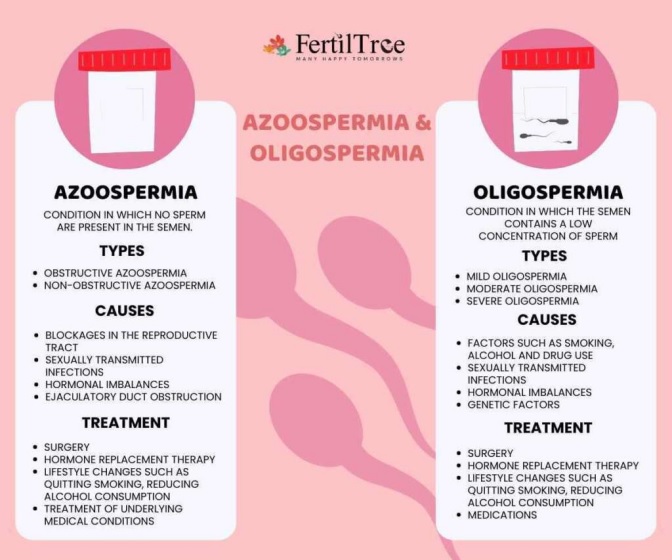
Both conditions are diagnosed on a semen analysis — two separate samples collected after two to five days of abstinence, to rule out day-to-day variation. The critical difference is binary: sperm are either absent or below threshold.
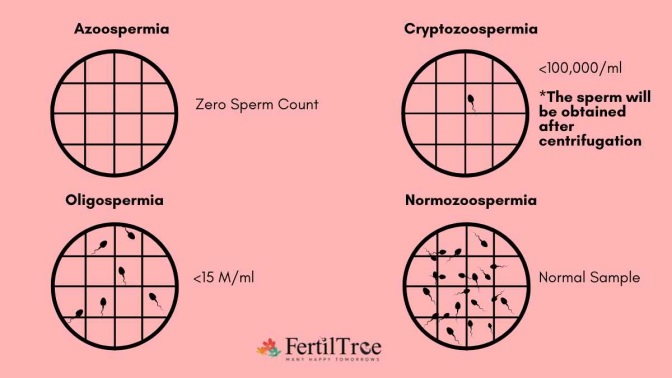
Azoospermia is the complete absence of sperm in the ejaculate, confirmed only after the sample is centrifuged and the pellet examined. It affects approximately 1% of all men and 10–15% of men presenting to a fertility clinic. Oligospermia is a count below 15 million sperm per millilitre — the WHO lower reference limit for fertile men.
Between them sits a third category most clinics do not name explicitly: cryptozoospermia — fewer than 100,000 sperm per millilitre, visible only after centrifugation. This distinction matters because even a small centrifuged pellet may allow ICSI without surgical sperm retrieval — a path that many men are never told is open to them.
Feature | Azoospermia | Oligospermia |
Definition | No sperm in ejaculate (confirmed after centrifugation) | Sperm count below 15 million/mL (WHO 2021 lower reference limit) |
Prevalence | ~1% of all men; 10–15% of infertile men | ~15% of men in couples trying to conceive |
Cryptozoospermia? | Borderline: found only after centrifugation | Not applicable (sperm detectable on standard prep) |
Types | Obstructive (~40%) / Non-obstructive (~60%) | Mild / Moderate / Severe + OAT syndrome if motility/morphology also low |
Natural pregnancy? | Extremely unlikely without intervention | Possible in mild cases; requires ART in moderate–severe |
Primary treatment | Surgical sperm retrieval (PESA, TESA, microTESE) + ICSI | Lifestyle → varicocele repair → IUI → IVF/ICSI (by TMSC and severity) |
Types: OA, NOA, and OAT Syndrome — What Most Sites Miss?
Azoospermia splits into two clinically distinct types. Obstructive azoospermia (OA, ~40%) means sperm production is normal but a physical blockage prevents sperm from reaching the ejaculate — vasectomy, CBAVD (congenital bilateral absence of the vas deferens, linked to CFTR gene mutations), or post-infection epididymal scarring. Non-obstructive azoospermia (NOA, ~60%) means the testes themselves produce little or no sperm — from Klinefelter syndrome (47,XXY), Y-chromosome microdeletions, prior chemotherapy, or primary testicular failure.
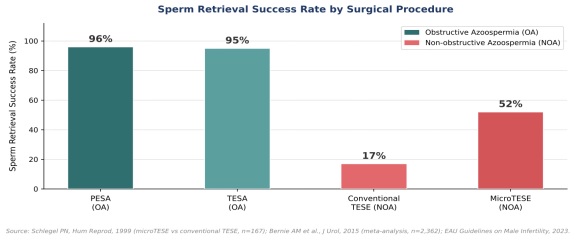
This distinction is the single most important factor in treatment: in OA, sperm can be retrieved surgically in roughly 95–96% of cases; in NOA, retrieval using microTESE succeeds in approximately 40–60% of men.
OAT syndrome — the combined defect no competitor article explains. OAT stands for Oligoasthenoteratozoospermia: a count below 15 million/mL AND motility below 40% (asthenozoospermia — the motility component) AND normal morphology below 4% (teratozoospermia — the morphology component), all present at once. The WHO Laboratory Manual identifies OAT as the most common combined sperm defect in infertile men.
Why does it matter? IUI relies on a sufficient pool of motile, normally shaped sperm. OAT syndrome — even with counts that technically fall within mild oligospermia — makes IUI very unlikely to succeed. These men need IVF with ICSI, and sometimes IMSI treatment (sperm selection at very high magnification) if standard ICSI has repeatedly failed without explanation.
The Number That Actually Matters: Total Motile Sperm Count
Most articles — and many online semen analysis portals — report only sperm concentration. Doctors use a different number: Total Motile Sperm Count (TMSC). TMSC = ejaculate volume (mL) × sperm concentration (million/mL) × progressive motility (%). It tells you how many actively swimming sperm exist in the entire ejaculate — not per millilitre.
A man with 12 million sperm/mL but low volume and low motility may have a TMSC of only 2–3 million. A man with 10 million sperm/mL but excellent motility and 3.5 mL volume may have a TMSC of 28 million. These are very different clinical pictures — yet they look identical on a headline “sperm count” reading.
TMSC is what determines the next step. The EAU Guidelines on Male Infertility (2023) and the ASRM Practice Committee use these thresholds:
TMSC | Classification | Who Sees It | Recommended Next Step |
>20 million | Normal | Normal fertile range | Natural conception or expectant management |
10–20 million | Mild reduction | Mild oligospermia with good motility | IUI is viable; consider female factors first |
5–10 million | Moderate reduction | Moderate oligospermia / OAT syndrome | IUI borderline; IVF/ICSI preferred |
<5 million | Severe reduction | Severe oligospermia / azoospermia | IVF with ICSI strongly recommended |
<0.1 million | Cryptozoospermia | Near-azoospermia (pellet only) | ICSI with centrifuged sample; surgical retrieval if pellet insufficient |
Practical takeaway: ask your lab report for ejaculate volume, concentration and progressive motility — then multiply them together. If the result is below 5 million, the next conversation should be about IVF/ICSI, not IUI. If you want to bank multiple semen samples before a procedure, TMSC per sample determines how many viable vials you can store.
Sperm DNA Fragmentation: The Hidden Test
A man can have a “normal” sperm count and still fail IVF cycle after cycle — and no one explains why. In many of these cases, the answer is sperm DNA fragmentation (DFI): the percentage of sperm in a sample that carry broken DNA strands. Standard semen analysis does not measure DFI. It requires a separate test — either the TUNEL assay or the Sperm Chromatin Structure Assay (SCSA) — that most routine work-ups do not include.
A 2014 meta-analysis by Simon et al. found that elevated DFI significantly reduced IVF and ICSI live birth rates. Clinical thresholds widely used in practice:
- DFI below 15%: Good prognosis for IVF/ICSI.
- DFI 15–25%: Fair prognosis; some impact on IVF outcomes, particularly blastocyst development.
- DFI above 25–30%: Elevated risk of IVF failure. Repeated negative cycles with ejaculated sperm are an indication to consider testicular sperm extraction, since testicular sperm (collected surgically) typically have lower DFI than ejaculated sperm.
Varicocele raises DFI independent of sperm count — Smit et al. showed that microsurgical varicocelectomy reduced DFI measurably, separate from the improvement in sperm count. This is one reason varicocele repair is worth considering even in men with mild oligospermia.
Who should request DFI testing? Men with two or more failed IVF/ICSI cycles despite good embryo quality, unexplained male-factor infertility, recurrent pregnancy loss, or significant varicocele — regardless of their sperm count. Discuss this with your male infertility specialist before the next cycle.
Why Sperm Are Under Attack: Oxidative Stress, COVID-19 and India's TB Factor
The underlying mechanism of most male infertility — regardless of diagnosis — is oxidative stress. Reactive oxygen species (ROS) damage the polyunsaturated fatty acid-rich sperm plasma membrane and fragment sperm DNA. A systematic review by Agarwal et al. found that excess ROS were implicated in 30–80% of infertile men. Sources include varicocele, infections that damage sperm, obesity, tobacco, heat exposure, environmental toxins, and certain medications.
What competitors do not mention: COVID-19.
SARS-CoV-2 gains entry to testicular cells via ACE2 receptors, triggering an orchitis-like inflammatory response. A 2021 study by Guo et al. found significantly reduced sperm concentration, total motility, and morphology in men who had recovered from moderate-to-severe COVID-19 compared with pre-infection baseline values. Most parameters recovered by 6 months, but the transient damage is clinically significant for couples planning an IVF cycle.
Practical takeaway: men who had moderate or severe COVID-19 within the past 3–6 months should retest semen parameters before a planned IVF cycle and, where possible, delay sperm banking until recovery is confirmed.
India-specific warning: genital tuberculosis. India carries approximately 27% of the global tuberculosis burden. The genitourinary tract is involved in 2–10% of patients with pulmonary TB, and epididymo-orchitis or fibrotic blockage of the vas deferens can follow — often silently, without fever or classic TB symptoms. This makes genital TB a significant under-recognised cause of obstructive azoospermia in India that standard fertility investigations frequently miss.
Unlike most obstructive causes, active genital TB is treatable. Couples with unexplained male infertility in India should consider a Mantoux test, chest X-ray, and semen or urine AFB culture — especially with a history of TB exposure, or a past respiratory illness without documented resolution. Anti-tuberculosis therapy can, in selected cases, restore patency or prevent further damage if caught early.
The 70-Day Rule — Why Results Take Longer Than You Expect?
Spermatogenesis — the production of a new sperm cell from a stem cell in the testis — takes approximately 70 to 74 days. Any change affecting testicular function today (quitting smoking, repairing a varicocele, starting hormonal treatment, completing chemotherapy, treating genital TB) will not appear in a semen analysis for at least two to three months, because it takes that long for a new cohort of sperm to complete development and reach the ejaculate.
The EAU Guidelines on Male Infertility recommend a repeat semen analysis no earlier than 70–90 days after any intervention. Checking at four or six weeks is not premature caution — results at that point still reflect sperm produced before the treatment started.
Practical takeaway: no improvement at week four is not a failed treatment. It is a man who has not yet reached the 70-day window. Patience at this stage is not resignation; it is correct clinical practice.
Treatment Options — From Lifestyle Changes to Surgical Sperm Retrieval
For Oligospermia
- Lifestyle changes: Quitting smoking, reducing alcohol, achieving a healthy BMI, and avoiding heat exposure (laptops, hot baths) can all improve sperm counts within one 70-day cycle. These are always the starting point. Knowing the signs of unhealthy spermearly helps catch problems before they worsen. These foods can also help improve sperm count.
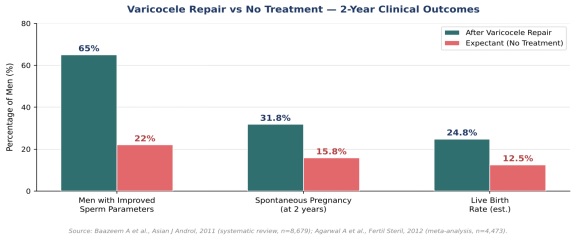
- Varicocele repair: Microsurgical ligation or radiological embolisation. A systematic review (Baazeem et al.) and meta-analysis (Agarwal et al.) found improved sperm parameters in ~65% of treated men and roughly double the spontaneous pregnancy rates versus untreated controls at two years (31.8% vs 15.8%).
- Assisted reproduction by TMSC: IUI when TMSC exceeds 5–10 million; IVF orICSI when TMSC falls below 5 million. IMSI is considered when high DFI or repeated ICSI failure is the concern.
For Azoospermia
- Obstructive azoospermia: PESA (percutaneous epididymal sperm aspiration) retrieves sperm directly from the epididymis — effective in close to 96% of OA cases (EAU Guidelines, 2023). Surgical repair of the obstruction (vasovasostomy) is an alternative for recent, reversible blockages.
- Non-obstructive azoospermia: MicroTESE is the gold-standard technique. A microsurgeon maps the entire testis under the operating microscope, finding tubules with active sperm production that standard TESA would miss. Bernie et al. found a pooled retrieval rate of 52%. Retrieved sperm are used withICSI at the FertilTree IVF centre.
Tracking hCG levels after IVF embryo transfer — not the retrieval alone — is the milestone confirming whether an embryo has implanted after a retrieval-and-ICSI cycle.
What the Data Says About Your Chances?
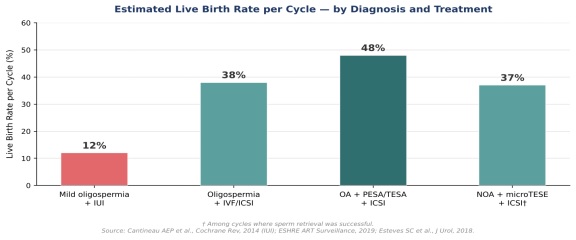
Prognosis tracks TMSC and type of condition:
- Mild oligospermia + IUI: Approximately 10–15% live birth rate per cycle in good-prognosis couples. IUI is appropriate only when TMSC exceeds 5–10 million.
- Oligospermia + IVF/ICSI: Live birth rates typically 35–45% per cycle — comparable to couples with other isolated male-factor diagnoses and a normal uterine and ovarian profile.
- Obstructive azoospermia + PESA/TESA + ICSI: Sperm retrieval in ~96% of cases; live birth ~48% per cycle.
- Non-obstructive azoospermia + microTESE + ICSI: Retrieval in ~52% of men overall; in cycles where retrieval succeeds, live birth ~37% per cycle. Sperm DNA fragmentation and the female partner’s age and ovarian reserve are the second-tier variables that shift individual prognosis above or below these averages.
Worth saying plainly: a successful microTESE + ICSI cycle at a centre experienced in azoospermia gives many NOA couples a realistic pathway to biological parenthood. This is not a guarantee — but it is a real option for most, not the exception.which type you have and why.
Bottom line
Azoospermia and oligospermia are not simply “none vs few” — the distinction between obstructive and non-obstructive azoospermia, between a TMSC of 2 million and 15 million, and between a DFI of 10% and 35% changes every treatment decision. Both are diagnosable; both have treatment pathways. The right path depends on which type you have and why.
Frequently Asked Questions
What is sperm DNA fragmentation and do I need the test?
Sperm DNA fragmentation (DFI) measures the percentage of sperm with broken DNA strands. A DFI above 25–30% is associated with poor IVF outcomes even when sperm count looks normal. The test is recommended after two or more failed IVF cycles, recurrent pregnancy loss, or unexplained male-factor infertility. Book a consultation to discuss whether DFI testing is right for your work-up.
Is oligospermia permanent? Can a man recover from a low sperm count?
Often no — many men recover significantly. Lifestyle changes (quitting smoking, healthy BMI, cutting heat exposure), varicocele repair, and hormonal treatment improve sperm count measurably in many men within 70–90 days — that is the time one full spermatogenesis cycle takes. Studies show varicocele repair improves sperm parameters in ~65% of treated men. Even when count does not fully normalise, IVF or ICSI gives most men a realistic path to biological parenthood regardless. Motility matters as much as count: check minimum sperm motility requirements for IVF to understand where your TMSC falls in the treatment pathway.
Can a man with azoospermia father his own biological child?
Yes. With surgical sperm retrieval (PESA, TESA, or microTESE) combined with ICSI, biological parenthood is a realistic goal for most men with obstructive azoospermia and for roughly half with non-obstructive azoospermia. Outcomes vary significantly by centre, hormone profile, and genetics.
What is the difference between PESA, TESA and microTESE?
PESA aspirates sperm from the epididymis with a needle — mainly for obstructive azoospermia. TESA removes a small amount of testicular tissue with a needle. MicroTESE uses the operating microscope to map the entire testis for pockets of active sperm production — it retrieves more sperm with less tissue damage and is the gold standard for non-obstructive azoospermia.
MEDICALLY REVIEWED BY
Dr. Firuza Parikh
MD, PhD, Director, Jaslok-FertilTree International Fertility Centre
Male-factor infertility — including azoospermia, oligospermia with elevated sperm DNA fragmentation, and OAT syndrome requiring complex assessment and surgical sperm retrieval — is one of the most frequent referral reasons at Jaslok Hospital. Dr. Parikh trained in IVF and Reproductive Endocrinology at Yale University School of Medicine under Dr. Alan DeCherney, established one of India’s first private-hospital IVF centres at Jaslok Hospital in 1989, and delivered South-East Asia’s first ICSI baby in 1994. Over more than three decades in reproductive medicine, she and her team have helped deliver more than 20,000 babies for patients from over 60 countries.