
Signs of Unhealthy Sperm: 5 Warning Signs to Know

Signs of Unhealthy Sperm: 5 Warning Signs to Know

Here’s the honest starting point most “signs of unhealthy sperm” lists skip: most sperm problems produce no visible signs at all. Count, motility, and shape can all be well outside the normal range while semen looks, smells, and behaves completely normally. That doesn’t make this question pointless — a handful of visible signs genuinely are worth knowing, and a lab report can tell you far more than any of them. This guide covers both: the signs actually worth watching for, and what your numbers mean against current WHO and Indian reference data, not the decade-old figures still floating around online.

Key takeaways

●       Most sperm quality problems have no visible signs — a normal-looking semen sample can still have low count, motility, or DNA integrity.

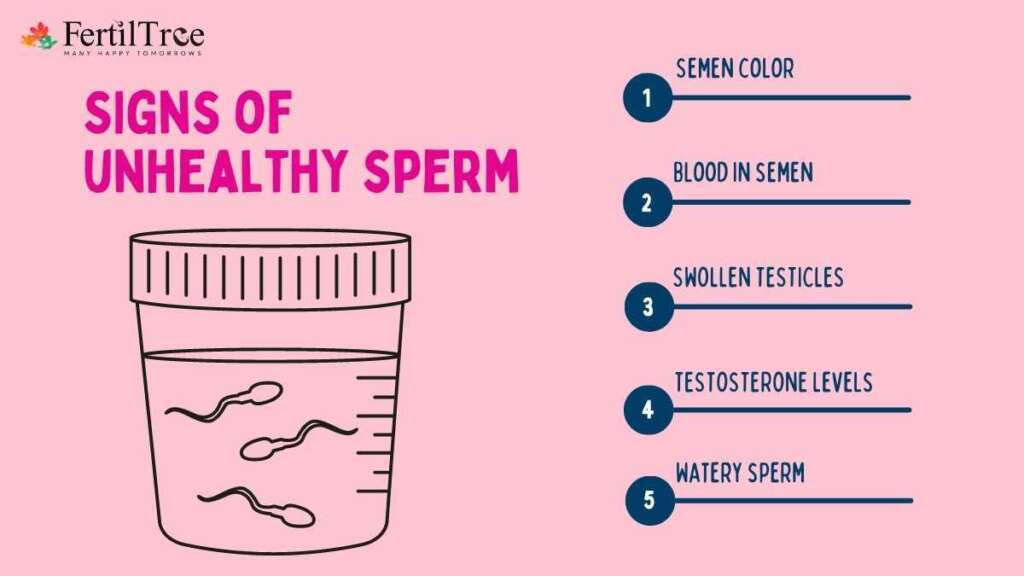
●       Five visible signs are still worth knowing: unusual color, blood, testicular swelling, low-testosterone symptoms, and unusually watery semen.

●       The reference values changed in 2021 — WHO’s 6th edition lowered some thresholds from the 2010 figures many sites still quote.

●       Indian reference data looks meaningfully different from global averages, and “declining sperm counts” is a genuinely contested claim, not a settled fact.

●       DNA fragmentation can be abnormal even with a normal count — a separate test most standard semen analyses don’t include.

●       A semen analysis is the only way to know for certain — nothing here replaces it.

Why Most Sperm Problems Don't Show Any Signs?

This is worth saying plainly, because a lot of content built around “signs of unhealthy sperm” quietly implies more than the evidence supports: the sperm parameters that matter most for fertility — concentration, motility, shape, and DNA integrity — aren’t things you can see, smell, or feel. A semen sample can look, in every visible way, completely typical while still falling well outside normal ranges on a lab report. That’s not a reason to ignore this topic — it’s the reason a semen analysis exists at all, rather than relying on self-inspection. The handful of genuinely visible signs below are real and worth acting on, but they’re the exception, not the rule.

The 5 Visible Signs Worth Knowing

None of these confirm a problem on their own, and a lab test is the only way to know for certain — but they’re worth paying attention to.

Sign

What It May Indicate

Urgency

Yellow or green-tinted semen

High sulfur-food or alcohol intake, or a possible bacterial infection

Worth mentioning at your next visit

Blood in semen (hematospermia)

STI, prostatic infection, or urethral trauma

See a doctor promptly

Testicular swelling

Inflammation or a hydrocele

See a doctor promptly

Low-testosterone symptoms (low energy, low libido, mood changes)

Possible testicular under-function

Worth discussing at your next visit

Consistently watery or very low-volume semen

Possible low sperm count (semen is normally thick)

Reasonable to get a semen analysis


This is a general guide, not a diagnosis — a semen analysis is the only way to confirm what any of these signs actually mean for you.

What a Lab Report Actually Measures?

Three measurements form the core of a standard semen analysis: count (concentration), motility (movement), and morphology (shape). It’s worth knowing the reference values changed in 2021 — the World Health Organization’s 6th edition replaced the widely quoted 2010 figures, and quite a bit of content online (including, until recently, some of our own) still cites the older numbers.


How WHO reference values shifted between the 2010 (5th edition) and 2021 (6th edition) manuals.

These values are best understood as decision limits — the bottom 5% of a large sample of recently fertile men — rather than a strict pass/fail line. A result just under the line is a flag for further evaluation, not a diagnosis of infertility on its own.

Where You Stand: Indian Reference Data

Global WHO figures are useful, but they’re pooled from labs worldwide. A large Indian analysis — pooling data from 6,466 fertile and 7,020 infertile Indian men across studies published between 1979 and 2016 — gives a regional comparison point:


Mean semen parameters, fertile vs. infertile Indian men.

You may also have come across the claim that Indian sperm counts have fallen sharply over the past few decades — it’s a genuinely debated point, not a settled one. Some earlier Indian data support a temporal decline, particularly among infertile men. But a 2025 study from Kasturba Medical College, Manipal, reviewing 12,151 men over 17 years (2006–2022), found no clear evidence of decline over that period at their center. The honest summary: trends vary by region and population, and a single national number doesn’t capture the full picture — your own test result matters far more than either side of this debate.

DNA Fragmentation: What Your Count Doesn't Tell You?

A standard semen analysis can look entirely normal while sperm DNA integrity is not — which matters because higher DNA fragmentation is linked to lower pregnancy rates and higher miscarriage risk. This is measured separately, using tests such as SCSA, TUNEL, the sperm chromatin dispersion (SCD) test, or the Comet assay.


Conditions most strongly associated with elevated sperm DNA fragmentation.

DFI Result

General Interpretation

Below ~15%

Considered a good result in most labs

Roughly 15–30%

Borderline — often discussed alongside other findings, not viewed in isolation

Above ~30%

Associated with lower pregnancy rates and higher miscarriage risk in the research above


Exact cutoffs vary by lab and test method — always interpret your specific result with your clinician.

Self-Check: Should You Get Tested Now?

Your Situation

Likely Next Step

No visible signs, trying to conceive less than 6 months

Reasonable to keep trying naturally for now

No visible signs, trying to conceive 6–12+ months, or age 35+

Worth getting a baseline semen analysis

Any of the 5 visible signs above, or trying 12+ months with no visible cause found

See a specialist and get tested promptly

What Happens Next?


Bottom line

Most sperm problems can’t be seen — a handful of visible signs are worth knowing, but a semen analysis against current WHO 2021 and Indian reference data tells you far more than any of them can.

Want your own results explained rather than matched against a generic list? Book a consultation at FertilTree — we can walk through your specific report with you directly.


Frequently Asked Questions

What are the signs of unhealthy sperm?

Unusual semen color, blood in semen, testicular swelling, low-testosterone symptoms, and unusually watery or low-volume semen — though most sperm problems show no visible signs at all, and a lab test is the only way to know for certain.

What is a normal sperm count under WHO 2021?

The current lower reference limit is 16 million sperm per mL, or 39 million total per ejaculate — down from the 2010 figures some sources still quote.

Are Indian sperm counts really declining?

It’s genuinely debated. Some earlier data show a decline, particularly among infertile men, but a 2025 South Indian study of over 12,000 men found no clear decline over 17 years at their center. Regional and population differences make a single national answer misleading.

What does a high DNA fragmentation index mean?

It means sperm genetic material is more damaged than typical, which is linked to lower pregnancy rates and higher miscarriage risk — even when a standard semen analysis looks normal.

Can diet and lifestyle actually improve sperm health?

Yes — maintaining a healthy weight, quitting smoking, moderating alcohol, and eating an antioxidant-rich diet are associated with better semen parameters over a full ~74-day sperm production cycle.

MEDICALLY REVIEWED BY

Dr. Firuza Parikh

MD, PhD, Director, Jaslok-FertilTree International Fertility Centre  ·  Last updated August 2026

Male-factor findings are a recurring part of Dr. Parikh’s consultations, and the conversation almost always moves quickly past “visible signs” to what the actual lab numbers show. She trained in IVF and Reproductive Endocrinology at Yale University School of Medicine under Dr. Alan DeCherney, established one of India’s first private-hospital IVF centres at Jaslok Hospital in 1989, and delivered South-East Asia’s first ICSI baby in 1994 — a treatment developed specifically for significant male-factor infertility. Over more than three decades in reproductive medicine, she and her team have helped deliver more than 20,000 babies for patients from over 60 countries. Read more at Dr. Firuza Parikh’s full profile.