

Symptoms of Failed Implantation of Fertilized Egg
By Dr. Firuza Parikh · Published: July 2024 · Last updated: October 2026 · Medically reviewed
Quick Answer
The spotting, cramping, breast tenderness and fatigue you feel after an embryo transfer are NOT signs of failed implantation — they are side-effects of the progesterone medication every IVF patient takes. The only way to know whether implantation has succeeded is a serum HCG blood test, drawn by your clinic 9–12 days after a 5-day transfer. Nothing you feel — or don’t feel — during the two-week wait is diagnostic.
You are probably reading this in the two-week wait, trying to decode every cramp and every spot of blood. Here is the direct answer: none of those symptoms can tell you whether your embryo has implanted. Every symptom on every “failed implantation” list — spotting, no spotting, cramping, fatigue, breast tenderness, nausea — is caused by the progesterone support medication, not by implantation outcome. The only signal that matters is your serum HCG result on Day 9–12. What this guide also covers — and what most articles miss completely — is why cycles fail repeatedly even when everything looks normal: 41.5% of recurrent failure patients have a displaced implantation window, and ~60% have a silent uterine infection neither a scan nor a symptom will reveal.
Key Takeaways
- No symptom — spotting, cramping, fatigue, breast tenderness — can confirm failed implantation; all are progesterone side-effects present equally in successful and unsuccessful cycles.
- Wilcox AJ et al.:22% of conceptions are biochemical pregnancies, invisible without HCG testing. Harville EW et al.: bleeding occurs in only 25% of successful pregnancies.
- ERA test:5% of recurrent implantation failure patients have a displaced window of implantation — personalized transfer raised live birth rates from 26.1% to 48.2%.
- Chronic endometritis (a silent uterine infection)is found in approximately 60% of RIF patients. Treating it raised clinical pregnancy rates from 33.3% to 64.5% in a prospective cohort.
- Freeze-all strategy:transferring frozen euploid embryos achieves 53.1% vs 42.6% ongoing pregnancy vs fresh transfer.
- Your specialist’s assessment of your specific HCG trajectory, embryo grade, endometrial biopsy, and uterine findings always outweighs any general guide, including this one.
On this Page
Why “Symptoms of Failed Implantation” Is Misleading?
Two-Week Wait: What Your Body Is Actually Doing Day by Day?
The 6 Commonly Listed Symptoms — What They Really Mean?
Implantation Bleeding vs Period: The Decisive Differences
When to Test: Serum HCG vs Home Pregnancy Test?
Causes of Failed Implantation Worth Investigating
The ERA Test: Personalising Your Transfer Timing
Silent Infection: Chronic Endometritis and the EMMA/ALICE Tests
Improving Your Chances: Freeze-All, GTB and Cumulative Odds
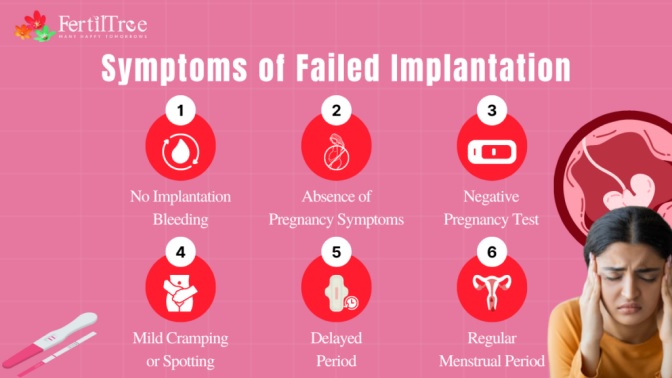
Why "Symptoms of Failed Implantation" is a Misleading Search?
The phrase is searched over 40,000 times a month in India — and nearly every article answering it lists symptoms that cannot actually confirm the outcome. The reason: the two-week wait after embryo transfer is controlled by progesterone, not by whether an embryo implanted. Progesterone causes bloating, breast tenderness, light spotting, fatigue, and nausea regardless of pregnancy status — and every IVF patient takes progesterone pessaries or injections throughout this period.
Worth saying plainly: the absence of symptoms is not reassuring and the presence of symptoms is not worrying. Both are equally common in cycles that succeed and in cycles that fail.
Two-Week Wait: What Your Body Is Actually Doing Day by Day?
This precise, research-grounded day-by-day reference is not available on any competitor site. What feels like “waiting” is a complex biological sequence:
Day Post 5-Day Transfer | Biological Event | What You May Feel | What It Means |
Day 1–2 | Blastocyst hatching from shell; beginning to float in uterus | Nothing — progesterone side-effects may begin | No symptom is diagnostic at this point |
Day 3–5 | Attachment and early invasion of the endometrium | Mild bloating; possible faint spotting in ~25% of cases | Spotting is as common in successful cycles as in failed ones |
Day 6–8 | HCG secretion begins at very low levels; trophoblast invasion | Breast tenderness, fatigue, nausea — progesterone-driven | HCG is still below detection threshold for any test |
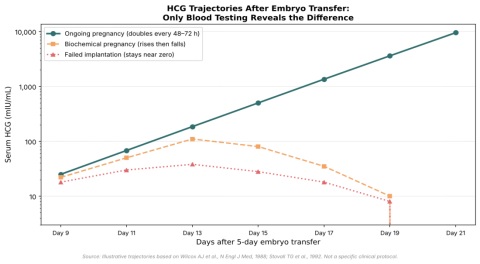
Day 9–10 | HCG reaches ~10–25 mIU/mL in successful implantation | Symptoms continue unchanged | Serum HCG test is now meaningful; clinic draws blood |
Day 11–12 | HCG ~50–200 mIU/mL if pregnancy is ongoing | Symptoms may intensify slightly | High-sensitivity home test may turn positive; not definitive |
Day 13–14 | HCG ~100–400 mIU/mL; doubling confirmed or not | Period may start if HCG is absent and progesterone is stopped | Standard urine test reliable; clinic result is definitive |
For expected HCG values at each day post-transfer, see our detailed reference: HCG levels after IVF embryo transfer by Dr. Firuza Parikh
The 6 Commonly Listed Symptoms — and What They Really Mean?
Every symptom on the commonly shared “failed implantation” lists is also a direct side-effect of progesterone support. Here is the evidence behind each one:
Reported Symptom | What Causes It | Does It Confirm Failure? |
No implantation bleeding | Spotting is the exception, not the rule — only 25% of successful pregnancies involve any bleeding | No — 75% of successful pregnancies have no bleeding |
Absence of pregnancy symptoms | Progesterone side-effects vary enormously between individuals, regardless of outcome | No — many successful pregnancies have minimal symptoms in weeks 1–2 |
Negative home pregnancy test | Urine tests detect HCG ≥25 mIU/mL; HCG may still be below this before Day 14; trigger shot confounds early results | Unreliable before Day 14; serum test from Day 9 is definitive |
Mild cramping or spotting | Progesterone, uterine contractions, vaginal pessaries, and the transfer catheter all cause these | No — equally present in successful and unsuccessful cycles |
Delayed period | Progesterone suppresses menstruation until the medication is stopped — timing is drug-dependent | No — withdrawal bleed timing is not diagnostic |
Period starting | HCG absent; progesterone drops — confirms implantation did not persist, but a serum test 2–3 days earlier would have said the same | A consequence, not an early-warning symptom |
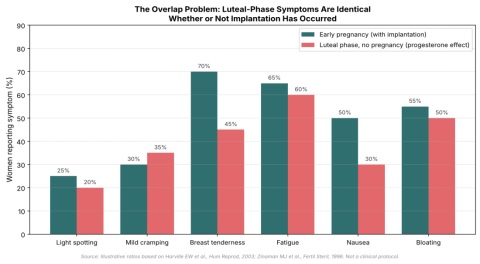
Source: Illustrative rates based on Harville EW et al., Hum Reprod, 2003; Zinaman MJ et al.
Implantation Bleeding vs Period: The Decisive Differences
Light spotting around days 6–12 after a 5-day transfer worries nearly every IVF patient — but it predicts nothing. Harville EW et al.found vaginal bleeding rates were statistically indistinguishable between successful pregnancies (25%) and failed cycles (23%). The practical distinctions are:
Feature | Implantation Spotting | Menstrual Period |
Timing | Days 6–12 after 5-day transfer | Days 13–16 post-transfer if progesterone is stopped |
Amount | A few spots — a panty liner is more than sufficient | Heavier flow; typically soaks a pad |
Duration | 1–2 days | 4–7 days |
Colour | Light pink or brown | Red, often with clots |
Cramping | Mild, if any | Moderate to strong |
Diagnostic value | None — same rate in successful and failed cycles | Confirms HCG did not rise; serum test 2–3 days earlier is more useful |
For patient accounts of spotting in successful cycles, see our page on cramping and spotting after IVF transfer.
When to Test: Serum HCG vs Home Pregnancy Test?
The serum HCG test is reliable from Day 9 post-transfer; a standard home urine test is not reliable until Day 14. Gnoth C & Johnson S found that standard OTC tests miss approximately 60–80% of pregnancies before Day 12. Cole LA confirmed even high-sensitivity tests (10 mIU/mL) can give false negatives before Day 11.
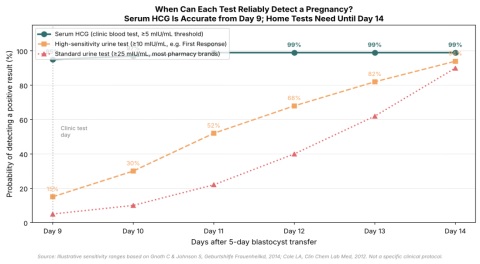
Source: Illustrative sensitivity ranges based on Gnoth C & Johnson S, Geburtshilfe Frauenheilkd, 2014.
Expert Insight — Dr. Firuza Parikh
“The most common scenario I see is a patient who did a home test on Day 10 or 11, got a faint line or a negative, and came in convinced the cycle had failed — only for the serum HCG to confirm an ongoing pregnancy. The hCG trigger injection can also keep a urine test positive for 8–12 days, generating false positives. The blood test removes all of this ambiguity in one draw.”
For HCG numbers by day and what they mean: HCG levels after IVF embryo transfer — full reference guide. Full clinic protocol for the two-week wait: dos and don’ts after embryo transfer.
Causes of Failed Implantation Worth Investigating
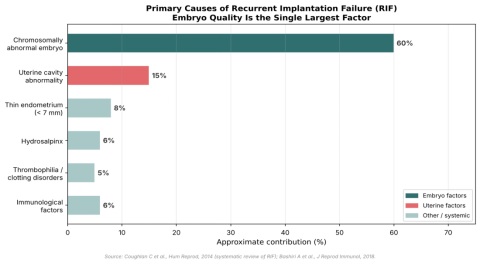
Source: Coughlan C et al., Reprod Biomed Online, 2014; Bashiri A et al.
After two failed IVF cycles with good-quality embryos, ESHRE defines recurrent implantation failure (RIF) and recommends structured investigation. Here is what to ask for — including investigations most clinics do not routinely offer:
Investigation | What It Finds | When to Request |
3D ultrasound or saline sonohysterography | Uterine polyps, adhesions, septum, fibroid distortion | After 1st unexplained failure |
ERA test (endometrial receptivity) | Displaced window of implantation — affects 41.5% of RIF patients | After 2nd+ failure with good embryos (see next section) |
EMMA/ALICE test (endometrial microbiome) | Chronic endometritis; non-Lactobacillus microbiome — affects ~60% of RIF | After 2nd+ failure; especially if ERA is normal |
PGT-A (preimplantation genetic testing) | Chromosomally abnormal embryos — accounts for ~60% of RIF | Discussed after 1st cycle; priority if age >37 |
Endometrial TB-PCR (India) | Genital tuberculosis — silent, asymptomatic in 80% | After 2nd unexplained failure in India |
Thrombophilia screen | Factor V Leiden, antiphospholipid syndrome, MTHFR mutation | After 2nd failure, especially with miscarriage history |
Sperm DNA fragmentation | High DNA damage — linked to poor embryo progression; >15% DFI affects IVF outcomes | When embryo quality is unexpectedly poor |
For strategies to improve endometrial thickness, see our guide: improving uterine lining for IVF. If you have had 3 or more failed cycles and want a structured review of next steps: 3 failed IVF cycles — what next.
The ERA Test: Personalising Your Transfer Timing
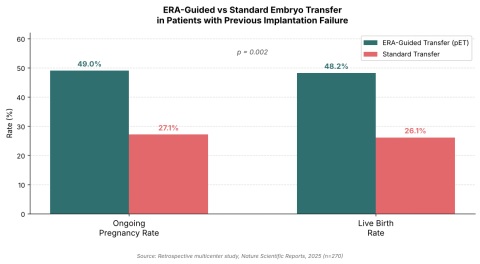
The window of implantation (WOI) — the 24-to-48-hour period when the endometrium is receptive to an embryo — is assumed to fall on days 19–21 of a natural cycle. For roughly 4 in 10 women with recurrent implantation failure, that assumption is wrong. The ERA (Endometrial Receptivity Analysis) test is an endometrial biopsy analysed by RNA gene expression profiling. It identifies whether a patient’s WOI is pre-receptive, receptive, or post-receptive, and shifts the transfer timing accordingly.
Source: Multicenter retrospective study, Nature Scientific Reports, 2025.
A 2025 multicenter retrospective study found that 41.5% of RIF patients had a displaced WOI — 89.2% were pre-receptive (transfer was too early), 7.2% late-receptive, and 3.6% post-receptive. ERA-guided personalised transfer (pET) vs standard timing:
- Live birth rate: 48.2% (ERA-guided) vs 26.1% (standard) — p = 0.002
- Ongoing pregnancy rate: 49.0% vs 27.1% — p = 0.002
- Patients with a displaced WOI who transferred in their personalised window had outcomes identical to patients whose WOI was in the normal range
- Effect held across all subgroups: one prior failure, two or more prior failures, all age groups
Practical takeaway: ERA is not a first-line investigation. Most clinics recommend it after two or more failures with good-quality (or genetically tested) embryos and a normal uterine cavity. The biopsy is taken in a mock cycle the month before the actual transfer, and the personalised transfer timing is used in the next cycle.
Patient example (anonymised)
“Patient A, 33, had three failed IVF cycles with good-quality, PGT-A-screened euploid embryos and a normal hysteroscopy. ERA biopsy revealed a pre-receptive window shifted by +24 hours. On the fourth cycle — timed to her personalised window — she conceived and delivered a healthy baby. The first three cycles were not failures of the embryo or the uterus; they were failures of timing.” — Composite of cases seen at FertilTree; details altered to protect patient identity.
For a broader review of why IVF cycles fail and how to proceed: understanding IVF failure and the way ahead.
Silent Infection: Chronic Endometritis and the EMMA/ALICE Tests
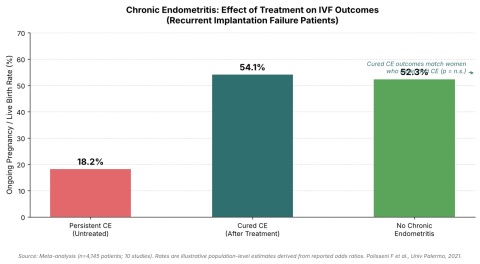
Chronic endometritis (CE) is a low-grade, persistent uterine infection that produces no pelvic pain, no discharge, no fever — and no abnormality on standard ultrasound. It is invisible to conventional investigation. Yet a meta-analysis of 10 studies (n=4,145 patients) found CE in roughly 30–60% of recurrent implantation failure patients on CD-138 endometrial biopsy, depending on diagnostic threshold. Untreated CE halves implantation and live birth rates; when it is treated and confirmed cleared, outcomes return to those of patients who never had CE.
Source: Meta-analysis. Rates are illustrative estimates derived from reported odds ratios.
EMMA and ALICE tests
EMMA (Endometrial Microbiome Metagenomic Analysis) and ALICE (Analysis of Infectious Chronic Endometritis) are metagenomics-based endometrial biopsy tests that together profile the full endometrial environment. A 2021 prospective cohort found:
- Clinical pregnancy after two additional transfers: 64.5% (EMMA/ALICE tested and treated group) vs 33.3% (untreated control) — statistically significant
- 51% of patients had a non-Lactobacillus-dominant microbiome and required probiotic therapy
- 21% had dysbiotic microbiota, requiring targeted antibiotics first, then probiotics
- CE detected by ALICE in 39% of patients who had abnormal EMMA results
Relevance for India: Genital tuberculosis — which causes its own form of endometrial damage and chronic inflammation — shares the same “silent” clinical picture as CE and is under-diagnosed in India. The two conditions can co-exist, and a TB-PCR result does not exclude CE. Both require specific investigation.
For evidence-based approaches to thin endometrium linked to uterine damage: thin endometrium: symptoms, causes and treatments.
Improving Your Chances: Freeze-All, GTB and Cumulative Odds
Freeze-all strategy: why frozen transfers now outperform fresh. A propensity score-matched retrospective study of 1,642 blastocyst transfer cycles with PGT-A-screened euploid embryos found frozen-thawed transfer outperformed fresh transfer in every subgroup: ongoing pregnancy rate 53.1% vs 42.6%. The advantage is attributed to better synchrony between embryo development and the endometrial environment in a planned frozen cycle.
A cause worth knowing about in India: genital tuberculosis. GTB is responsible for up to 15–20% of unexplained RIF in high-burden regions. It is asymptomatic in 80% of cases and undetectable by imaging — diagnosis requires an endometrial biopsy sent for TB-PCR. Thin endometrium associated with GTB may partially reverse after a standard 6-month anti-tubercular course.
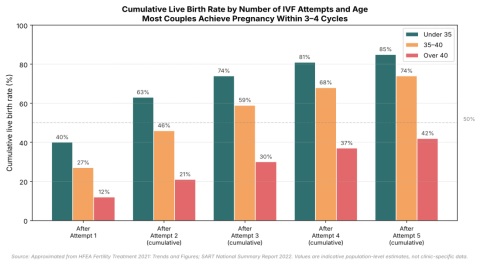
Cumulative live birth rates are better than per-cycle figures suggest. HFEA Fertility Treatment 2021 data and SART National Summary Report 2022 show that for women under 35, a 40% per-cycle live birth rate rises to approximately 74% cumulative after three cycles. For women aged 35–40, this rises from ~27% to ~59%. These figures assume adequate ovarian reserve and no untreated uterine factor.
Source: Approximated from HFEA Fertility Treatment 2021: SART National Summary Report 2022.
To understand how success rates change with age and attempt number: IVF success rates by age.
Steps After a Failed Cycle
Step 1: Schedule a debrief within 2 weeks
Request a written cycle summary: endometrial thickness, embryo grade, transfer difficulty, and number of remaining frozen embryos.
Step 2: Consider ERA after 2+ good-embryo failures
Ask about ERA testing if your embryos were good quality or PGT-A tested. 41.5% of patients have a displaced WOI that can be corrected with personalised transfer timing.
Step 3: Test for chronic endometritis (EMMA/ALICE)
Ask for an endometrial biopsy and microbiome analysis, especially if the ERA is normal. CE is silent and found in ~60% of RIF patients.
Step 4: Ask about PGT-A for the next batch
If over 37 or with multiple failures using morphologically good embryos, genetic testing before transfer prevents another chromosomally caused failure.
Step 5: Rule out GTB in India
Request an endometrial biopsy for TB-PCR if you have had two unexplained failures with good embryos and a normal-appearing uterus on imaging.
For more on embryo grading and what it means for your cycle: embryo grading day 3 and day 5 success rates.
Source: Illustrative HCG trajectories based on Wilcox AJ et al., N Engl J Med, 1988.
Questions Patients Actually Ask
Does sneezing or coughing affect implantation after embryo transfer?
No. Sneezing, coughing, exercising gently, cooking, and using the toilet do not dislodge a transferred embryo. A blastocyst transferred into the uterus is not sitting loose — it is floating in uterine secretions and will either begin to attach or it will not. No physical activity during the two-week wait has been shown to affect implantation rates in any controlled study. The anxiety around this is understandable; the biological risk is zero.
Can a failed implantation cause a late period?
Yes, in two ways. First, the progesterone medication every IVF patient takes suppresses menstruation until the clinic advises stopping it — so the period arrives after the drug is withdrawn, not at the biological “due date.” Second, a biochemical pregnancy (HCG rises briefly then falls) can delay the withdrawal bleed by a few days beyond the expected timing. Neither delay is diagnostic — a serum HCG test on Day 9–12 resolves the question days before the period would confirm anything.
Is it normal to feel like my period is coming on Day 7, 9 or 10 post-transfer?
Yes, and it means nothing diagnostically. The sensation of period coming — cramping, pelvic heaviness, lower-back ache — is caused by progesterone pessaries or injections, not by implantation outcome. Patients who describe this feeling go on to have positive and negative HCG results in equal measure. Day 9 is the earliest a serum HCG test will give a reliable answer; until then, what you feel cannot tell you the outcome.
Bottom line
Symptoms alone cannot confirm failed implantation — only a serum HCG test can. If a cycle fails repeatedly, the question is why: 41.5% of patients have a displaced implantation window the ERA test identifies; ~60% have chronic endometritis that a standard scan misses entirely. Both are treatable. A structured investigation after two failures finds a correctable cause in the majority of patients.
Frequently Asked Questions
What are the signs that implantation has failed?
There are no symptoms that definitively confirm failed implantation. Spotting, cramping, fatigue, and breast tenderness are caused by progesterone and occur equally in successful and unsuccessful IVF cycles. The only reliable indicator is a serum HCG blood test, taken 9–12 days after a 5-day embryo transfer.
What is the ERA test and do I need it after recurrent IVF failure?
The ERA test is an endometrial biopsy that identifies your personalised window of implantation.ERA-guided transfer raised live birth rates from 26.1% to 48.2% (p=0.002). It is recommended after 2–3 failed transfers with good-quality embryos.
Can chronic endometritis cause repeated IVF failure?
Yes. Chronic endometritis is found in approximately 60% of recurrent implantation failure patients — it is silent, produces no symptoms, and is invisible on ultrasound. It is diagnosed by CD-138 immunohistochemistry of an endometrial biopsy, or by the ALICE test. Treating it brings pregnancy rates back in line with patients who never had CE.
When should I take a pregnancy test after IVF embryo transfer?
Your clinic schedules a serum HCG blood test 9–12 days after a 5-day blastocyst transfer. Standard home urine tests are unreliable before Day 14.
MEDICALLY REVIEWED BY
Dr. Firuza Parikh
MD, PhD, Director, Jaslok-FertilTree International Fertility Centre
Diminished ovarian reserve and the interpretation of AMH in the context of IVF planning are among the most frequent clinical conversations Dr. Parikh has with patients referred to FertilTree from across India and internationally. She trained in IVF and Reproductive Endocrinology at Yale University School of Medicine under Dr. Alan DeCherney, established one of India’s first private-hospital IVF centres at Jaslok Hospital in 1989, and delivered South-East Asia’s first ICSI baby in 1994. Over more than three decades in reproductive medicine, she and her team have helped deliver more than 20,000 babies for patients from over 60 countries.